
Turtle Classification
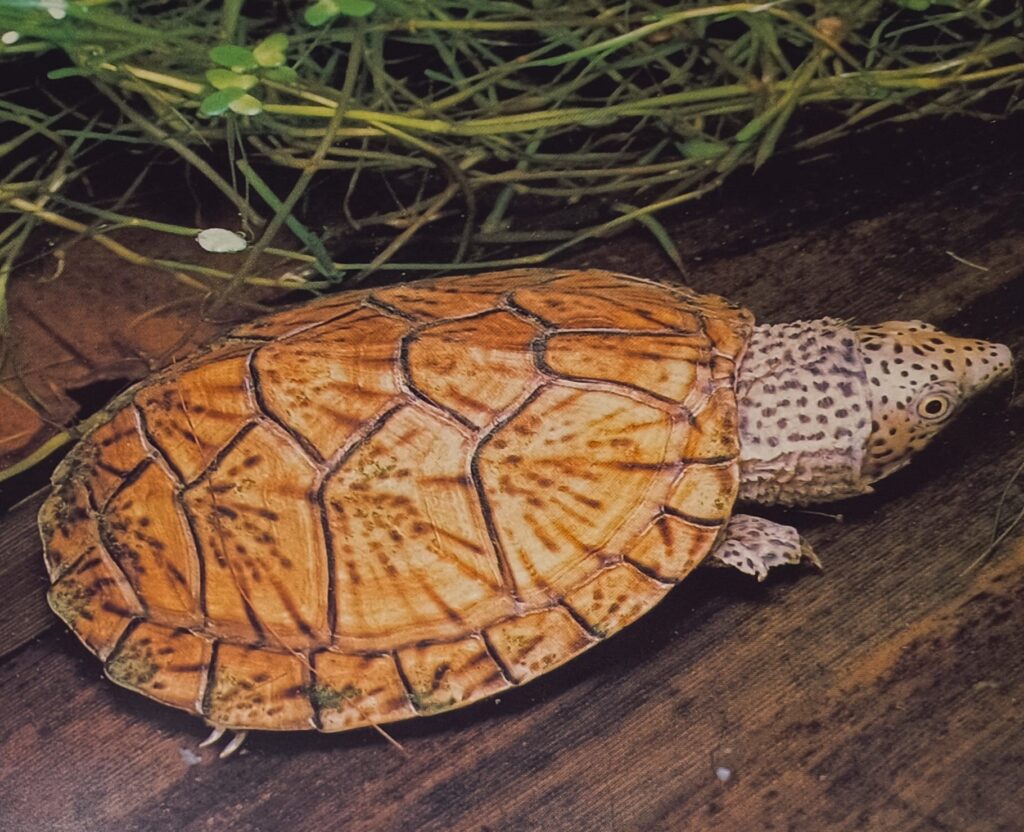
Turtle classification is based on their bone structure, with the skull's constitution being the predominant characteristic.
The most comprehensive classifications are those by Boulenger and Gadow, which are based on two groups. The first (Ateco) includes specimens whose shells are made up of numerous small irregularly arranged bony elements, and whose limbs are shaped like paddles, adapted to aquatic life. The second group (Thecophora) includes all the others.
Ateco Turtles
The Ateco turtle group includes only one family, the Esphargidae, which in turn refers to a single genus with only one species of sea turtle. This species is distinguished by its non-retractable neck and its dorsal and plastron shields covered by leathery skin. It is known as the leatherback turtle (Leatherback Sea Turtle), due to its back and the five longitudinal keels it has, giving it the appearance of that instrument.
It is one of the largest turtles alive today. Specimens measuring no less than 1.80 meters have been observed, with others reported around 2 meters long and weighing over half a ton. The leatherback is found in the Atlantic, Indian, and Pacific Oceans, and occasionally in other seas, although it is always rare.
Tecophorous Turtles
The Thecophora are distinguished by having vertebrae fused to the ribs, forming bony expansions that create a true shield covered by horny plates.
One characteristic detail is that if the neck is retractable, it folds into the space between the carapace and plastron, bending vertically in an S shape; additionally, the entire shell is covered with horny plates.
The Chelidrids
They Chelidrids, a family of long-tailed turtles with a small plastron, a very narrow bridge connecting it to the carapace, and a sharply hooked snout or beak. They are American. They are distributed in two genera, each with a single species.
One of them is the marsh turtle, which is found in slow-flowing rivers and swamps, from southern Canada to Central America. Mainly in those with muddy bottoms and even in pools of stagnant water.
The snapping turtle (Chelydra serpentina), which can reach up to 1 meter from the tip of the snout to the end of the tail. It is very voracious and feeds on fish, amphibians, and prefers deep waters. Sometimes it is seen floating, carried by the current, with only the tip of its snout or beak above water, quickly diving at the slightest alarm. It is often found out of the water, where its movements are slow, similar to those of crocodiles. The name snapping turtle has been given due to its aggressive instinct, which is observed even in newly hatched specimens. During summer, it lays 20 eggs, which are edible. In captivity, it refuses all food. Its neck and limbs are so robust that they cannot be fully retracted into the shell.
Very close to this species is the alligator turtle (Macroclemmys temmincki), native to the Mississippi and Missouri basins.
The Kinosternids and Plastisternids
The kinosternids are found in North and Central America. They belong to the genus Kinosternon. The most interesting are the stinkpot turtle (Kinosternon odoratum) and the box turtle (Kinosternon leucostomum).
The stinkpot turtle named so because of the foul smell of the secretion from their inguinal glands. Due to the shape of the shell, the box turtle
The Pennsylvania terrapin (Kinosternon pennsylvanicum), very abundant in the southeastern United States and very voracious. Its meat is not edible, and it proves to be a good swimmer and clever hunter of its prey. It often swallows fishermen's hooks, who mistake it for a large fish. During winter, it hides among moss and does not resume activity until spring.
Testudinids
The largest number and the main living turtles within the classification belong to the family Testudinidae. They have a retractable neck and a shell always fully covered with horny plates. It includes genera that comprise terrestrial, amphibious, or aquatic, distributed across almost all countries except Australia and New Guinea.
The genus Pseudemys includes some American turtles of freshwater, with a flat shell, short tail, and limbs with interdigital membranes, whose species are found throughout America.
The painted terrapin (Pseudemys scripta), found in the state of New York and Long Island, has a smooth, flat, and depressed carapace, dark olive or dark brown in color, with broad yellowish stripes on the front of the neural and costal plates, while the marginal plates are reddish and the plastron is yellow.
It provides details about their growth, explaining that during the first six or seven years of life the painted terrapins grow regularly, as evidenced by the successive layers of horny plates. But after this stage, due to a fusion process, the epidermis becomes smooth, making it more difficult to determine their age.
The size of adult individuals is 16 cm in carapace length by 11 cm in width.
In Central America, there is a related species: the ornate box turtle (Pseudemys ornata).
The genus Clemmys includes seven or eight species of marsh turtles, which have the shell and plastron rigidly connected, webbed toes, and a long tail without a terminal claw, longer in juveniles than in adults.
Among its species is the leprous tortoise (Clemmys caspica), named for its appearance when the plates and even the bones become gangrenous,


Related content