
Star Tortoise
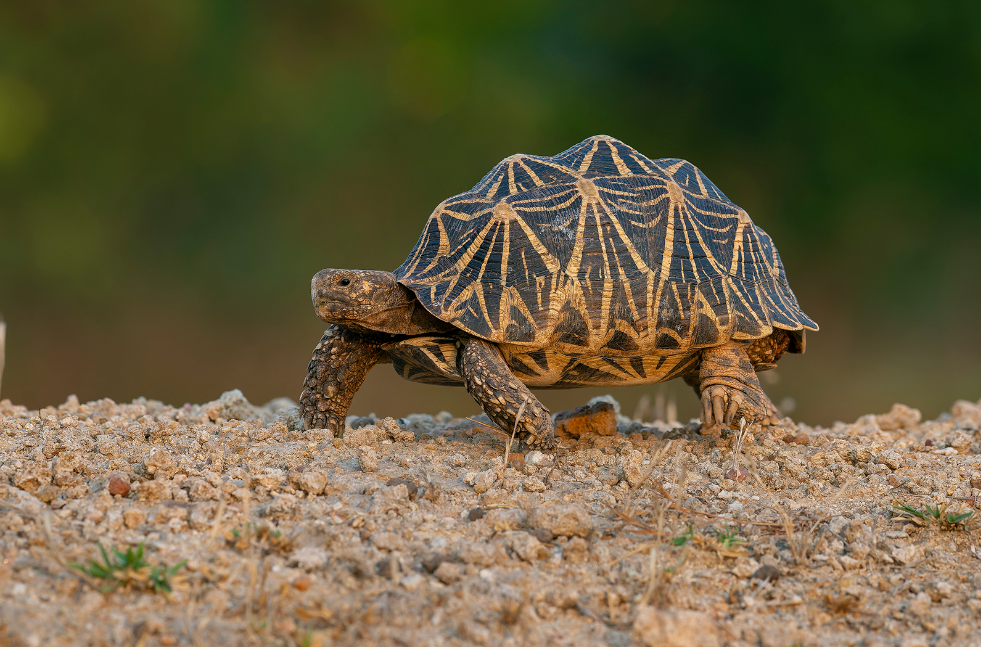
The star tortoise from India (Indian Star Tortoise) is a land tortoise known as the Sri Lanka star tortoiseis a species of tortoise native to the dry forests of India and Sri Lanka. This species is notable for its star-patterned shell, which resembles a star with multiple yellow points. The genus Geochelone is the one it belongs to. If you want to keep learning more about the Indian star tortoise, we now describe more information about its distribution, characteristics, habits, diet, reproduction, and conservation status.
Distribution
This species is found in India and Sri Lanka. The star tortoise from India lives in two distinct areas: in the west, from Gujarat to the Pakistani border, and in the east, from the southern Ganges delta to the tip of the peninsula. Although some sightings have also been recorded in Pakistan and Bangladesh, it generally inhabits dry areas rather than wet ones.
Characteristics
There are other types of star tortoises besides India, also belonging to the family Geochelone. To distinguish the species Indian Star Tortoise Compared to other star tortoises, the following characteristics can be observed:
The radial scutes of the shell they have a conical shape and the rear marginal scutes are slightly serrated in juveniles. The shell is slightly narrower in the middle and lacks a nuchal scute. The black and yellow stripes extend around the entire areola, while in the species Radiated Tortoise, they form a narrow fan on about 1/4 of the scute.
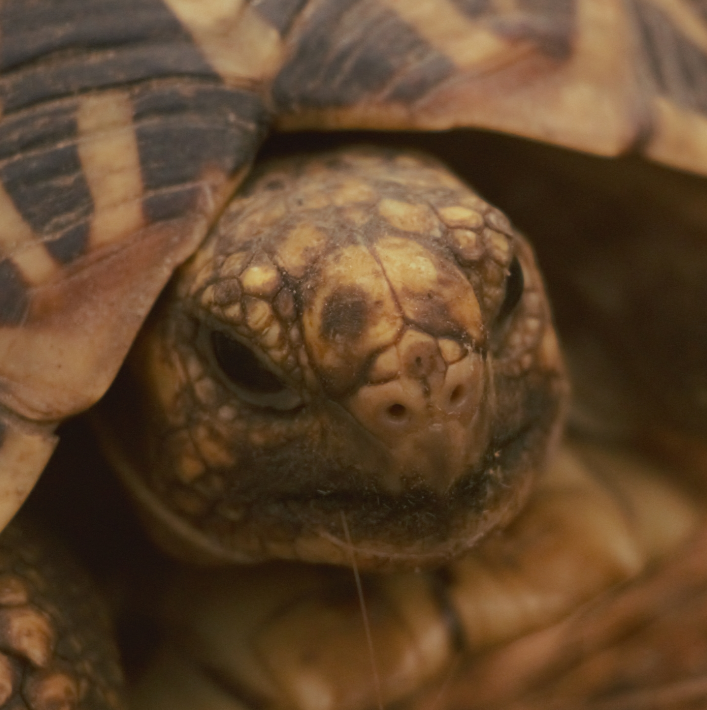
The legs are short, with flat, round scutes bordered in black, and the head has small yellow scales on a black background. The plastron is yellow with black stripes, and females are larger than males. Juveniles are yellow or orange with black markings along the sutures.
Habits
It is mainly found in the dry areas of Tamil Nadu, where there are grasses, acacias, and euphorbias. Another area where it can be found is in some green meadows in northern and western India. During the dry season, it is usually active in the morning and hides during the day, while in the wet season, it becomes very active, feeds abundantly, and mates.
In the western part of its range, it spends several weeks in hibernation due to low nighttime temperatures.
How long does the star tortoise live?
The star tortoise is a long-lived turtle due to its slow life cycle, and it can live up to 80 years.
How big do star tortoises get?
The maximum length it can reach is 32 cm, although its average size is usually 25 cm, and it does not exceed 6 kg. Typically, female star tortoises are larger than males, as is common in many other species.
Star tortoise care
It is recommended to provide a large water container for bathing, hiding spots, and a slightly dry floor. You should place heat lamps and UVA raysUVB, and maintain a daytime temperature of around 27°C and a nighttime temperature of 21°C. It is also noted that they like to bathe and be in the rain, but they do not tolerate humidity well. If kept outdoors, a solid fence is recommended to prevent escape.
No products found.
What does the star tortoise eat?
Its diet is mainly herbivorous, and it likes fruits, vegetables, and succulents, although it can also eat dead and thorny leaves. In Sri Lanka, it is known to consume papaya fruits, which can cause intestinal blockages and death. Other foods it eats include lizards, dead rats, and insects.
Feeding in captivity
The feeding star tortoises, we must consider the ratio calcium/phosphorus, since a calcium deficiency can lead to serious health problems, such as shell deformity. For this reason, it is recommended to provide foods with a ratio of at least 2:1, although this ratio may vary in nature.
We should provide natural foods to the tortoises whenever possible, such as charlock, dandelion, or sow thistle, which are plants usually easy to find. If these foods are not available, calcium supplements can be sprinkled or cuttlebone offered for the tortoises to nibble at will.
Any type of animal protein should be avoided in the tortoises' diet, as this can lead to health problems such as severe pyramiding, as well as damage to internal organs, especially the liver and kidneys.
How does the star tortoise reproduce?
Sexual maturity is reached at an early age, around 5 or 6 years. The mating period coincides with the monsoon month, and males have spectacular erections. Male courtship is brief and not aggressive, without injuring or biting the females, and they emit a moderate grunt during copulation.
How many eggs does the star tortoise lay?
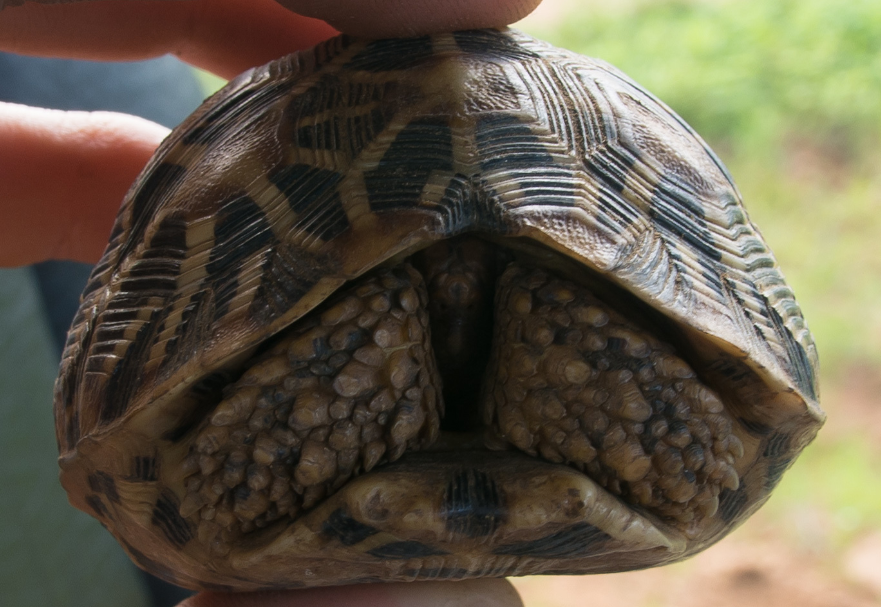
Egg-laying is mainly observed in May-June and October. The eggs are elliptical but sometimes tend to be spherical, and they are quite large for this small species: 3 x 4 cm. Incubation lasts from 110 to 130 days, and a female can lay around 10 eggs in the same season.
Conservation status
The population of this tortoise is rapidly declining due to three main threats:
Collection for international tradeintended for Asian and Western countries, collection for consumption, and intense urbanization and agriculture that transforms natural habitats. The rapid deforestation in India, along with intensive grazing and expansion of cultivated areas, is causing its rapid decline, as it once occupied the entire country.
Protection measures
Stricter protection measures are proposed, such as its inclusion in Appendix I (currently in Appendix II), the creation of truly effective and monitored reserves, and extensive environmental education for local populations. Exports must be stopped and studies on the species' status should be conducted.
Other species of land tortoises
There are numerous species of land turtles worldwide, each with unique characteristics and adaptations to their specific habitat. Some examples include the Desert tortoise, which can survive in extremely dry and hot areas; the Box turtle, which defends itself from predators by closing its shell; and the Galápagos tortoise, which can live up to 100 years and is known for its large size and longevity. All these species, like the Indian turtle, face threats from human activity and need protection measures to ensure their survival.
Argentine Turtle
Carbonaria Tortoise
Leopard Tortoise
Moorish Tortoise
Galápagos Tortoise
Mediterranean Tortoise
Despite its beauty, the star tortoise faces a series of threats in its natural habitat. Habitat loss due to agricultural expansion and urbanization, as well as poaching for the pet trade and traditional medicine, are the main factors affecting this species.


Leave a Reply