
Mediterranean Tortoise
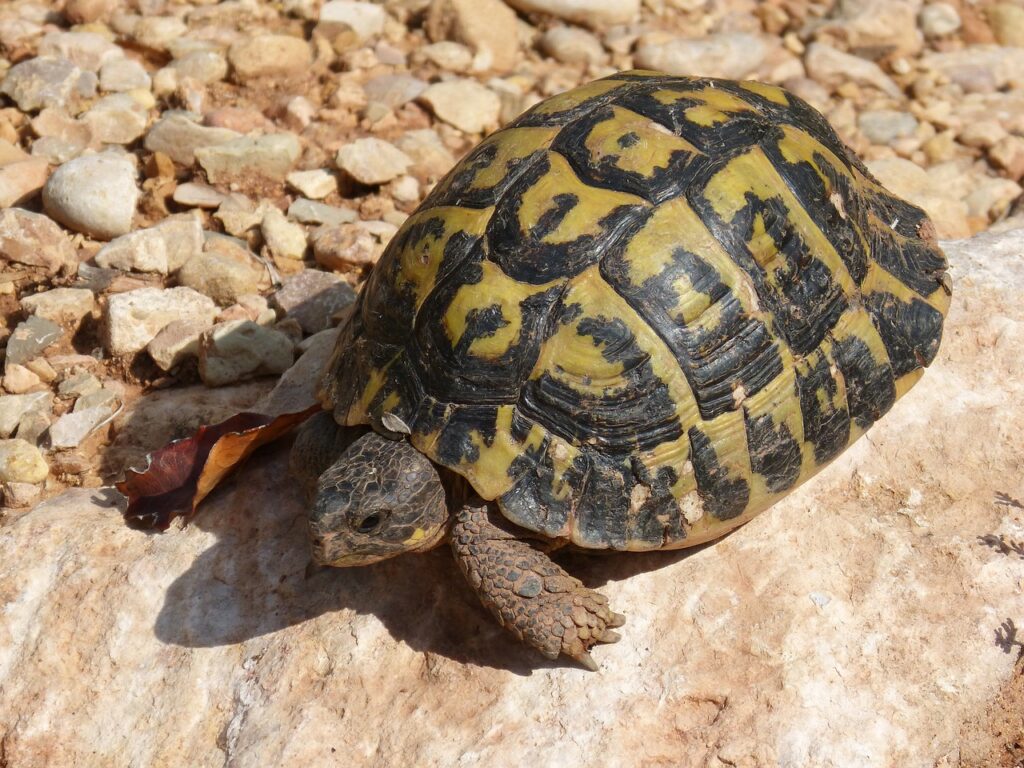
The Mediterranean tortoise (Hermann's tortoise), is a species of land tortoise native to the Mediterranean regionfrom Spain to Turkey. It is a land tortoise that prefers to live in dry, rocky habitats such as scrublands and shrub areas.
Distribution of the Mediterranean Tortoise
The Mediterranean tortoise is found in southern Italy, southeastern France, and northwestern Spain. Also on the islands of Corsica, Sicily, Sardinia, Mallorca, and Menorca
Characteristics of the Mediterranean Tortoise
It was formerly divided into two subspecies, western and eastern. From a phylogenetic point of view, it is very similar to the Horsfield's tortoise. This tortoise can hybridize with the Horsfield's tortoise (Horsfield's tortoise) as observed in captivity and due to their close taxonomic relationship. The Horsfield tortoise is more specialized in digging.
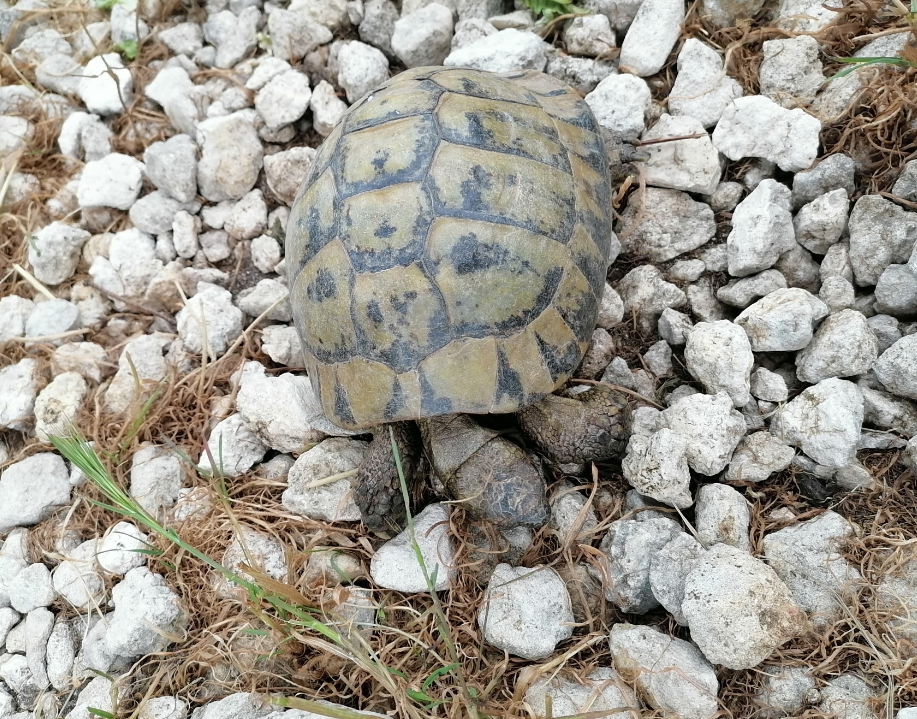
It has a claw on the tail which is more developed in males. It also has two black bands on the plastron. The carapace is domed and has no spurs behind the thighs. The head is marked with a yellow spot below and behind the tympanum.
The legs are grayish, marked with yellow. Males vary greatly depending on the region.
Habits of the Mediterranean Tortoise
The tortoise Mediterranean lives in the garrigue, maquis, and open forests of the Mediterranean area. It prefers semi-open environments where it can find shade and hide for hibernation. Its hibernation ends in late February and it mates immediately.
Hibernation in Provence begins in mid-November; the tortoise hides under a pile of leaves, in a burrow dug beneath a shrub, or under old rotten boards. It will spend the three winter months there and reappear in late February or early March, although there are significant individual differences. Some animals enter hibernation late hibernation and come out several times during winter, while others hide in late October and do not emerge until late March. Studies on thermoregulation have estimated the minimum and maximum temperatures this species can tolerate at the level of internal organs: a minimum of 4°C and a maximum of 35°C. Temperatures below or above these limits are lethal.
How Long Does the Mediterranean Tortoise Live?
The longevity or life expectancy of this species in its natural habitat ranges around 30 years, but many individuals can live up to 60 years and some live to be over a hundred years old.
What Size Is the Mediterranean Tortoise?
They can grow up to 19 centimeters in length and weigh around 3 kilograms. Female turtles, depending on the area, can reach up to 25 cm.
What Does the Mediterranean Tortoise Eat?
The diet of this species is 90% herbivorous. They like clover, dandelion, strawberry tree, yellow and white flowers, various plants and herbs from the maquis; occasionally they eat worms, snails, and even dead animals they find (lizards, young rabbits, or amphibians).
In captivity We can feed the Mediterranean tortoise with salad, using two or three of the following ingredients: leafy greens, either whole or cut into large pieces so the tortoises can bite and tear them themselves (various lettuces, cabbage, red cabbage, endives, lamb's lettuce, watercress, among others), large pieces of vegetables (broccoli, zucchini, pumpkin, carrot, green beans, asparagus, red pepper, among others), and wild greens (such as dandelion leaves and flowers, grass, chickweed, mulberry, alfalfa, among others). Then, we can sprinkle the supplement over the salad. It is important to note that 80-90% of the tortoises' diet should consist of leafy greens and wild vegetables, while only 10-20% should be other vegetables and garden produce. Fruit should be offered only occasionally, as a "treat."
Reproduction of the Mediterranean Tortoise
Females lay their eggs in shallow nests dug into the ground. They can lay up to 12 eggs in a single nest and may lay several nests during the mating season. The eggs take about 90 days to hatch.
Mating is not as aggressive as in Testudo graeca, although it follows the same ritual. In the French Provence, egg-laying begins around May 15 and ends in early July. The photoperiod triggers egg-laying more than ambient heat. The tortoises dig a pod-shaped nest about 6 to 10 cm deep and lay one to five eggs measuring around 3 cm.
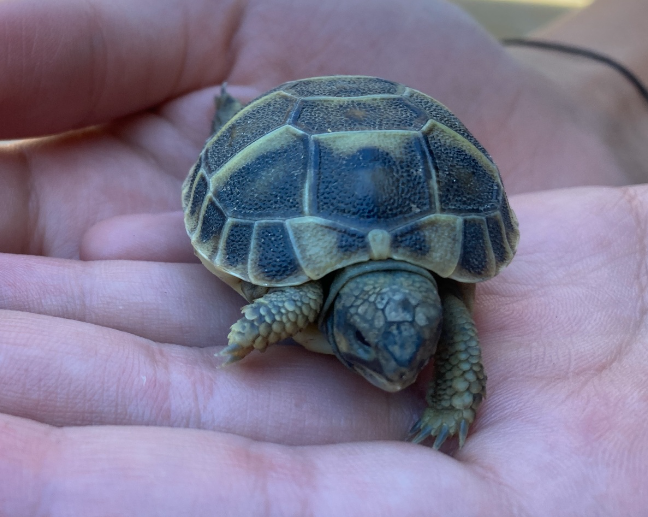
Sometimes there is a second clutch, three weeks after the first. Incubation lasts about 90 days, and hatching occurs after heavy rains in mid-August or September. If the hatchlings do not emerge due to lack of significant rainfall or a late clutch, they break their shell but remain underground, only emerging the following spring. They weigh around 10 g. The success rate of clutches in their natural habitat is 80%, but juvenile mortality is very high. Only four or five out of every 1,000 hatchlings survive after three years.
Sex determination in this species occurs at 28.5 degrees Celsius. If maintained at 26 degrees, only males are produced, but if kept at 30 degrees, only females are produced.
The species reaches sexual maturity at 8-12 years in males and 10-14 years in females.
Buy Mediterranean Tortoise
Mediterranean tortoises are fascinating animals and have become popular pets worldwide. However, it is important to remember that these tortoises are wild animals and should not be removed from their natural habitat. Capturing and selling Mediterranean tortoises is illegal in many countries and can harm their populations.
When you buy one Mediterranean tortoise it is important that specimens of this species have the necessary documentation to guarantee their legal origin. This means they must have been born in captivity and come from an authorized breeder. Certain documents are required to legally sell or transfer a specimen of this species.
Care of the Mediterranean Tortoise in Captivity
Habitat: It must have adequate space that allows it to move freely. An aquarium or terrarium should be at least four times the size of the tortoise's shell. It is important to have a place where it can bask in the sun and another where it can hide. Recommended size is 100 cm x 50 cm.
Water: To ensure the tortoise can easily access water, it is important that the water dish is positioned at a height proportional to the size of the tortoise. For example, if it is a Mediterranean tortoise a few months old, the height of the water dish should not exceed 1 cm.
Temperature: In the cool area, daytime temperatures should range between 22 and 26°C. In the warmer area, directly under the heat lamp, daytime temperatures should be between 30 and 35°C. At night, temperatures can drop to between 18 and 24°C, and a night lamp is not necessary.
Lighting: For Mediterranean tortoises, it is important to provide adequate lighting in their habitat. It is recommended to have a natural light source, either through a window or direct sunlight if kept outdoors. If this is not possible, artificial lighting can be used, such as UVB lamps and UVA, which simulate sunlight and are important for the synthesis of vitamin D and the overall well-being of the turtle. It is important to follow the manufacturer's recommendations regarding the intensity and duration of the lighting. Additionally, it is advisable to have a day and night cycle to maintain the turtle's circadian rhythm.
Feeding: As previously indicated.
Conservation Status
Until 1976, the turtle had been subject to intense collection and export, leading to its inclusion in Appendix II of CITES as a protective measure. During World War II, some residents of Provence consumed it due to food shortages. Until the mid-20th century, it was eaten in convents on fasting days, as it was considered, along with otters, snails, and frogs, as "neither meat nor fish." Currently, these Mediterranean turtles are affected by urbanization, habitat destruction, collection, and fires in these Mediterranean regions.
Today, the Mediterranean turtle only survives in a small area in central Var (and in Corsica), with its territory fragmented in Spain and Italy. Since 1986, various activities have been carried out to raise public awareness, conduct studies, and breed the species in captivity for reintroduction into its natural habitat. However, threats persist, such as urbanization in Var, which limits the living space of these turtles, and the proliferation of pet stores promoting them as pets, increasing commercial pressure and illegal collection. It is important to protect habitats, conduct studies, raise public awareness, and educate the population that these are wild animals, not pets. Due to its vulnerable status, the Mediterranean turtle is considered "endangered" by the Turtle Conservation Fund.
Other Types of Land Turtles
There are several species of land turtles worldwide, each with distinctive characteristics:
Argentine turtle
Star tortoise
Carbonaria tortoise
Leopard tortoise
Moorish tortoise
Galápagos Tortoise


Leave a Reply