
Shell with White Spots
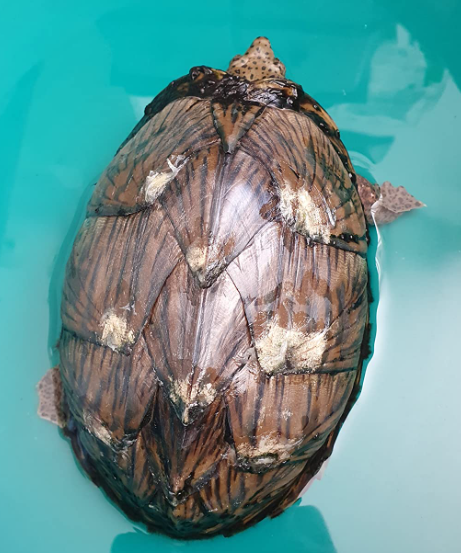
If your water turtle suffers on the shell white spots it can be due to different reasons. In this article, we will explain what white spots on the shell might be, why they appear, and what to do if your turtle has white spots on its shell.
The turtle's shell is a protective structure that covers its body and is made up of two main parts: the plastron, which is the underside, and the carapace, which is the top part.
What are the white spots on my turtle's shell?
The whitish spots can be caused by fungi on the shell. The aquatic turtles spend a lot of time in the water, so aquariums, aquaterrariums, or turtle tanks can become a source of fungi if not properly maintained.
When a turtle has fungi, it can be detected because in the early stages of infection the shell is covered by a fine layer or, in more advanced stages, by white or gray spots, sometimes even developing lumps or bumps. If it reaches an extreme case, please consult a veterinarian.
It is best to have an exotic animal veterinarian assess the situation, but if you cannot see a professional, this article explains what you can do if the infection is in its early stages.
Causes
Below we show possible causes of white spots on the shell:
When acquiring or adopting a turtle
If the turtle has not previously been kept in optimal conditions as we explained in the turtle article water, the turtle may develop fungi. It is important that if you are going to add a new turtle to your aquaterrarium you quarantine it first to avoid transmitting possible diseases or fungi to your habitat. Otherwise, you risk another turtle getting sick.
Poor water quality
One of the main problems we can face is poor water quality that this is caused by infrequent water changes, very stagnant water, or insufficient filtration. The water will be full of harmful bacteria for our turtle, resulting in illness. Turtles dirty the water a lot, either with their feces or decomposing food remnants.
It is always recommended to have a filter that circulates six times the volume of our aquarium or pond per hour. For example, if we have a 60-liter aquarium, we should have a filter that moves 300 liters per hour. We recommend using an external or cascade filter. If no filter is available, it is advisable to change the water every two days.
Incorrect temperature
The water temperature must be correct to prevent fungal growth. Ideally, the water temperature should be between 26 and 29 degrees Celsius. To control the water temperature, we should provide a Heater for turtle enclosure.
Lack of UV light
The absence of ultraviolet light in our turtles can cause fungal infections. If turtles do not have access to sunlight, they should be acclimated with a lamp that provides ultraviolet bulb (UVB). Fungi thrive in humid environments like turtle habitats, so a very important factor is that they have UV light.
Treatment for white spots on the shell
As mentioned earlier, it is best to consult a specialist to assess the condition of our turtle. Here we offer some tips you can follow.
Isolation
The first step is to isolate our turtle so it does not come into contact with other companions in its aquarium and risk spreading the infection, as fungi are highly contagious. We always recommend having a separate tank or aquarium to serve as a hospital if you have multiple turtles.
Terrarium cleaning
We must perform a complete water change in our aquarium, thoroughly cleaning the glass, stones, or other objects in contact with the water to eliminate fungi from the turtle's habitat. The turtle is in contact with the water and will carry fungal spores to reproduce.
Dry and brush
We dry the turtle and once dry, we gently brush it with a soft toothbrush. We brush the entire shell.
Keep dry
There are species of aquatic turtles that are very shy and fearful, so sometimes they rarely come out to the dry area even if it is suitable. If we notice that our turtle does not come out, we take it to a dry area without sunlight or UVB lamp and keep it there for about 45 to 60 minutes depending on the conditions. Important: if we take it out in the sun and the environment is very hot, we must provide shade to prevent heatstroke. Always keep it under supervision.
Salt baths
In a turtle tank or hospital aquarium, we can prepare a salt bath to eliminate fungi from the turtle's shell or skin. For this, we recommend adding common salt to the water and keeping the turtle in it for about 30 minutes. The water level should not exceed the height of the shell so the turtle can lift its head and avoid eye irritation. After the time is up, we empty the water, clean the container, and return the turtle to its natural conditions.
5% iodine
To eliminate turtle fungi, treat with a 5% iodine solution. First, dry the turtle completely, then apply the iodine solution mixed with a little water to the shell or skin using a cotton swab. It is important that the iodine does not come into contact with the eyes or is ingested by the turtle. Let the solution dry for about 30 to 60 minutes. After drying, rinse the turtle before placing it back in the water. The treatment should be repeated daily. Note: this is commonly available in many homes under the name Betadine.
Antifungal cream
This cream is a more specific and effective treatment than the previous one. The agent that removes white fungal spots from turtles is made of safe and environmentally friendly material, which is safe and healthy for the turtle. It does not affect water quality or aquatic turtles.
First, dry the turtles, moisten a cotton swab with an appropriate amount of antifungal cream, and apply it to the turtles' shells. Most white fungi disappear after applying twice a day for 5 to 7 days. If the situation is particularly severe, continue using it. It is recommended to keep using this product for 3 to 5 days after symptoms disappear to consolidate the effect.
No products found.


Related content