
Painted Turtle
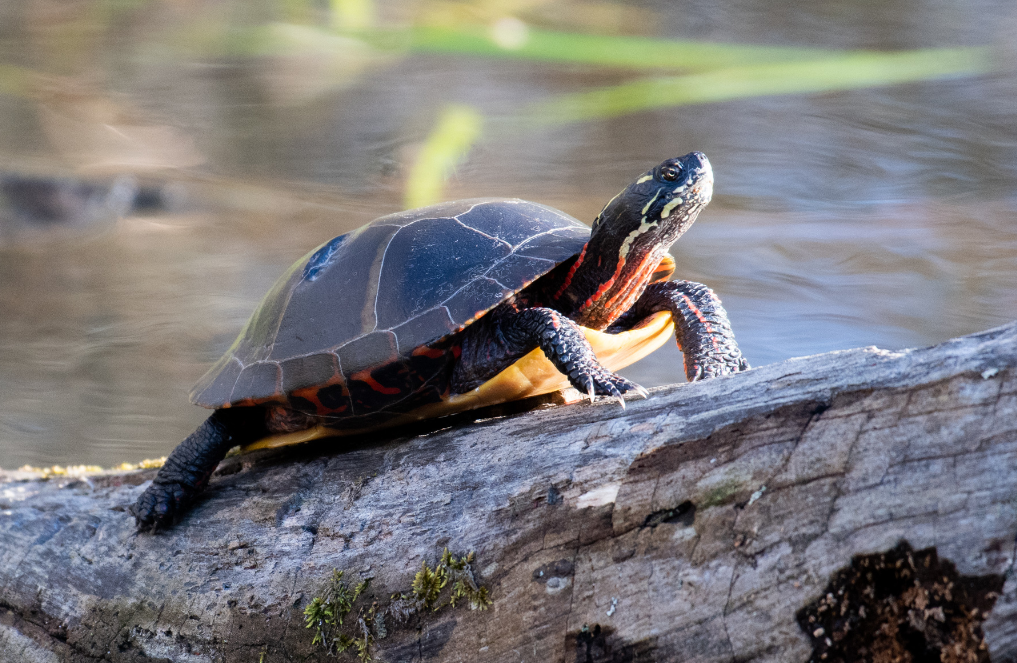
The painted turtle or Chrysemys picta by its scientific name is a very common aquatic turtle in our turtle tanks. It is also called the colored turtle. It is a chelonian from the Emydidae family and is the only one in the Chrysemys genus.
Distribution
It has the widest geographic distribution of any turtle species in North America. It is found from coast to coast, from southern Canada to the Gulf Coast of the United States.
Painted turtle characteristics
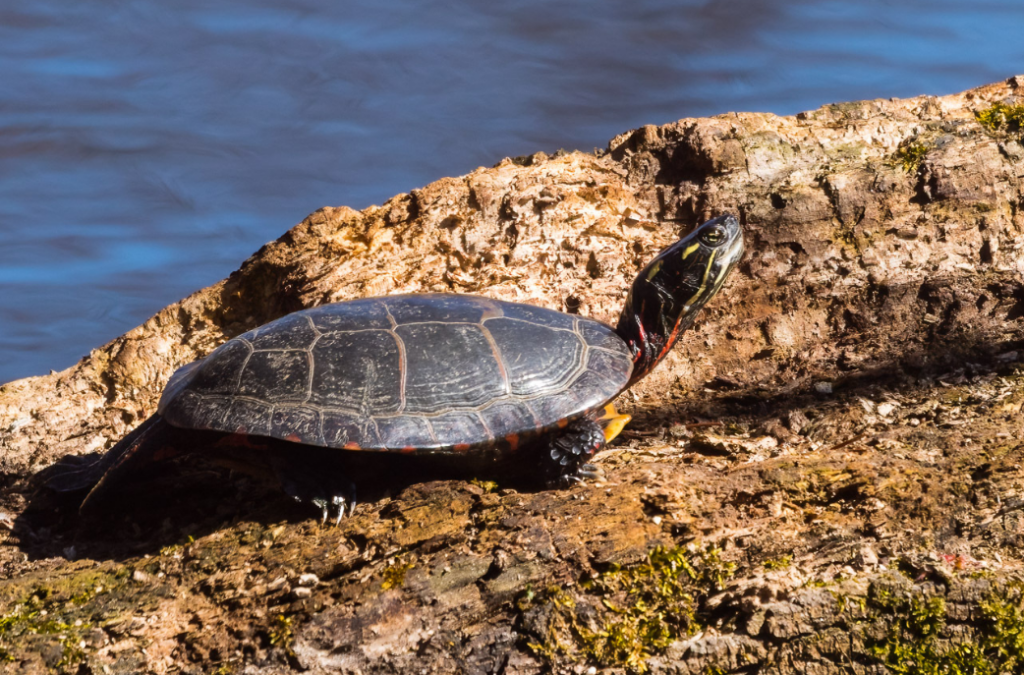
They have two large spots behind their cream-colored or light yellow head.
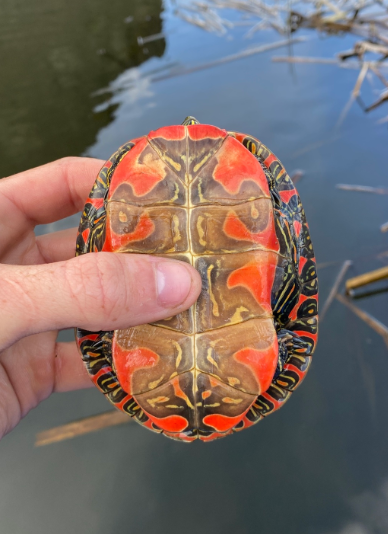
The plastron is mostly orange or reddish. Some subspecies may have patterns on their plastron, while others may have no patterns or markings on their shell. The shell is brownish with some red markings, and as they grow these may change to an olive green or greenish-brown tone.
Its coloration pattern is very distinctive, with red, yellow, and green markings on the top of its shell. The coloration pattern varies among painted turtle subspecies and can be more or less pronounced in different regions.
This turtle is found in a variety of aquatic habitats, including streams, rivers, lakes, and ponds. It is a semi-aquatic species and can spend long periods in the water, although it can also be found on land.
How long does a painted turtle live?
They can live up to 40 years in captivity.
How big does a painted turtle get?
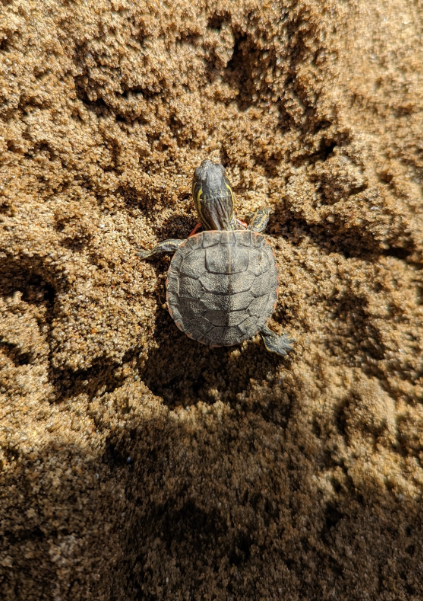
This turtle reaches a shell length of 8 to 18 cm, but large females can exceed 30 cm. Males are smaller and do not reach 25 cm.
What can it eat?
Regarding their diet, they are generally omnivorous turtles, meaning they eat fresh meat, fish, vegetables, and plants. They also eat typical turtle pellets or kibbles. Ideally, the diet should be as balanced and varied as we always recommend. If possible, try to offer a bit of everything, not just pellets or sticks.
And what is the point of having a varied diet? Simple: so our turtles get all the vitamins and nutrients they need for optimal development. We can offer them mealworms, cockroaches, crickets, snails, chicken heart, raw chicken or chicken liver (which is high in fat but a good source of vitamin A). We can also give them salmon (raw fish), earthworms, fresh shrimp, minnows, guppies, Molly fish, zebra fish, and a wide variety of fish.
All live food you give should come from a breeder. Remember it must be smaller than their head to avoid choking problems. In our feeding post we go into more detail.

- Contiene más de un 55 % de kril y de camarones por lo que es rico en ácidos grasos insaturados (omega 3)
- Las grasas naturales como proveedores de energía de alta calidad favorecen el metabolismo y refuerzan el sistema inmunitario de las tortugas
- La relación óptima entre calcio y fósforo favorece un caparazón sano y unos huesos fuertes
- La fórmula está elaborada con ingredientes naturales, por eso no contiene colorantes / Volumen de suministro: 1x Tetra ReptoMin Energy 250 ml

In their habitat, Chrysemys picta feeds on a variety of foods, including aquatic plants, aquatic insects, crustaceans, and other small animals. They are social animals and can be found in groups in feeding and resting areas.
Painted Turtle Reproduction
A painted turtle reaches sexual maturity at about 3-4 years of age.
They lay eggs several times a year as adults and are very active breeders. So if you have an adult female and an adult male, it is recommended to have a good dry area with soil for them to lay their eggs.
How to care for painted turtles?
The painted turtle or Chrysemys picta is a semi-aquatic turtle that usually takes long sunbaths to regulate its body temperature and grow strong and healthy. Sunbathing also helps them digest food and absorb nutrients, but if you can't provide natural sunlight, you must have a special UVB lamp for reptiles. The lamp should be on for 4 to 8 hours a day during the day to regulate their sleep cycle.

- Ideal para todo reptil habitante de desierto
- Alta producción de UVB
- Elevada conversión de D3
- Efectiva hasta 50 cm (20")
- Suministra los rayos UVB necesarios para el metabolismo óptimo del calcio
They require a large amount of water since they are excellent swimmers, so the more water they have, the better their development. They grow very quickly, and you must have a dry area for them to bask under their lamp or the sun. The dry area should be free from drafts because it is common for them to get pneumonia. You must also have a filter for excellent water quality to prevent diseases.
It is also important to have a adjustable thermostat if you live in very cold cities and do not have the right temperature, because they must always be kept between 24 and 27 degrees Celsius.
We must provide their dose of calcium, either with a calcium block that dissolves in the water or other forms that we will explain in another article.
Add dechlorinator to remove any chlorine particles in the water and also to prevent irritation to their eyes or skin if you do not use osmosis water.

- Para peces y plantas
- Para acuarios de agua dulce y tortugas
- Neutralización del cobre, el plomo y el zinc
- Protección de la membrana mucosa
Compatible species
These turtles can be mixed. Turtles are very easygoing and are compatible with many other turtles as long as they are the same size. You cannot mix large turtles with small ones, as the large ones can kill the small ones.
They are compatible with red-eared slider, peacock turtle, yellow-bellied turtle, red-bellied turtle, map turtle, false map turtle, or other chrysemys turtles among themselves.
Conservation status
Chrysemys picta (painted turtle), due to its colonizing potential and being a serious threat to native species, habitats, or ecosystems, has been included in the Spanish Catalogue of Invasive Alien Species, regulated by Royal Decree 630/2013, of August 2, and its introduction into the wild, possession, transport, trafficking, and trade are prohibited in Spain.
Invasive Exotic Turtles: Current European and Spanish Regulations
Current European and Spanish legislation strictly prohibits the acquisition, purchase, and sale of invasive exotic species, including Trachemys scripta and its subspecies such as the Red-eared Slider, Yellow-eared Slider, and the Painted Turtle (Chrysemys picta). These regulations aim to protect local ecosystems and prevent possible negative impacts on biodiversity, highlighting the importance of conserving and preserving native species.
Other types of aquatic turtles
European Pond Turtle
Hieroglyphic River Cooter
Red-Bellied Cooter
Spotted Turtle
South American Snake-Necked Turtle
Malaclemys terrapin