
Common Snapping Turtle
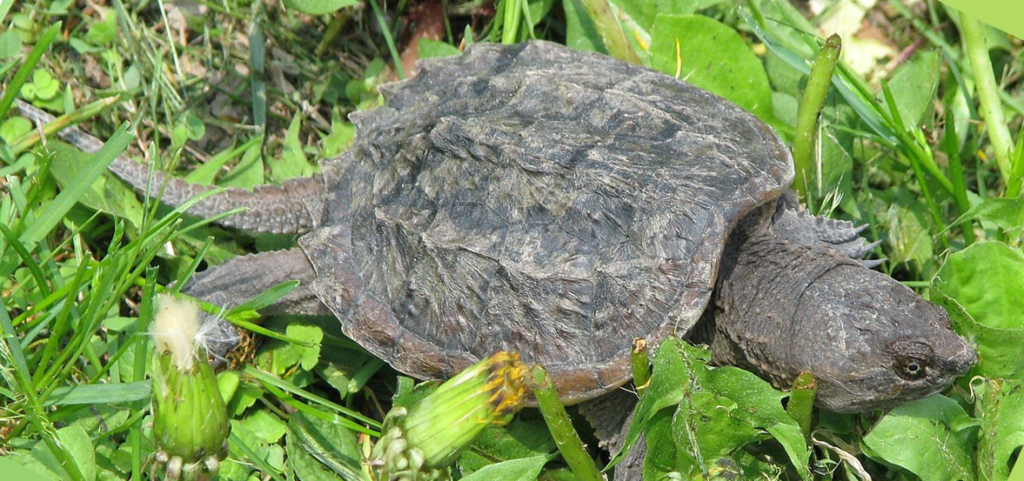
The snapping turtle (Chelydra serpentina) is a species of freshwater turtle found in North America. It is easily recognizable by its dark, rough shell, as well as its large, broad head with a powerful and sharp jaw. They are also known as alligator turtle, serpentine turtle, or northern alligator turtle.
Snapping turtles are known for their aggressive and territorial behavior. They often hide at the bottom of rivers and lakes, waiting for their prey to come close before attacking with their jaws. Along with the alligator snapping turtle, they are among the most dangerous turtles.
Distribution
Their range extends from southern Canada (Nova Scotia, New Brunswick, Quebec, and Alberta) to the southern United States, both in the central region and along the Atlantic coast.
Characteristics
The snapping turtle has a distinctive shell with three prominent keels that form bumps on each scute, while older individuals may have smoother carapaces. The marginals are strongly serrated and their color varies from brown, olive, to black, sometimes marked with radial lines in young individuals. The plastron is reduced and cross-shaped, allowing easy movement of the limbs, neck, and tail.
The head is large and broad, with the temporal region and the back of the skull covered by wide, flat, overlapping scales. The beak is cone-shaped and pointed, with a hooked upper jaw, and the jaws are powerful and well-developed to suit the biting nature of the species. The eyes are relatively small and located high on the head, while two pale barbels adorn the chin.
The species also has growths on the neck, legs, and tail. It has a long tail similar to that of a crocodile, with three rows of pointed scales on the upper side, and it can also be compared to a lizard-tailed turtle. Its legs are large and webbed, giving the animal a robust and vigorous appearance, and they have impressive claws.
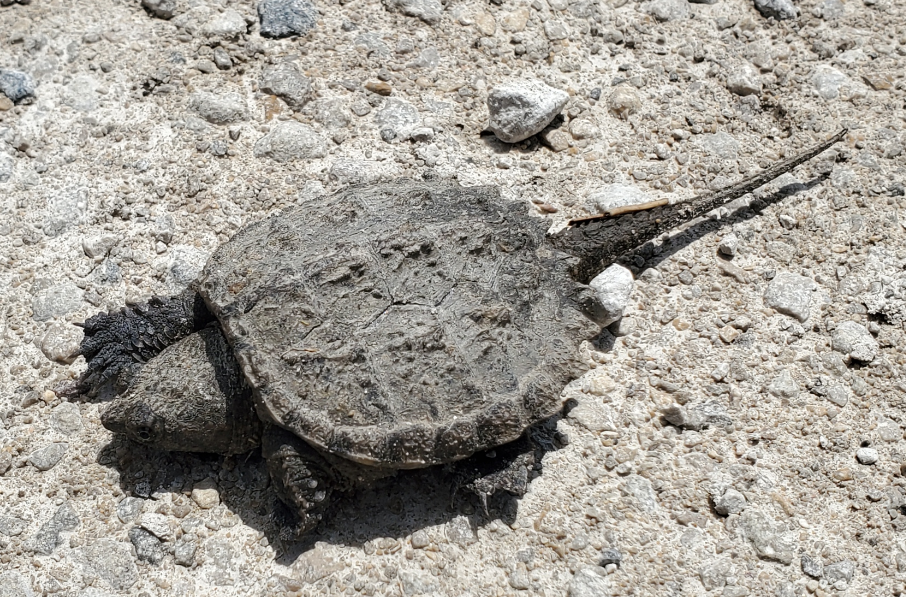
Overall, the species resembles a primitive and aggressive crocodile. Caution should be taken when handling this turtle due to its bites, as they are potentially dangerous. Even a baby snapping turtle, which may measure only about 3 cm, has three well-defined rough keels and can have gray, brown, or yellow coloring on each marginal.
Subspecies
There are two subspecies of the Snapping Turtle:
C.S. Serpentina (Common Snapping Turtle), which is found from southern Canada to northern Florida, United States.
C.S. Osceola (Florida Snapping Turtle), which is only found in Florida. The Florida Snapping Turtle is distinguished by having a greater number of pointed growths on the neck compared to the common subspecies. Although their exact function is not known for sure, it is believed these growths may be related to a form of cutaneous respiration.
Habits
This turtle's adaptability is remarkable, as it can be found in all wet environments within its range, even in brackish waters or highly polluted places. To camouflage and wait for its prey, it needs muddy bottoms and debris, so it hides in the silt. The turtle spends most of its time hidden in muddy bottoms, under roots and submerged stumps. Occasionally, it surfaces, leaving only its nostrils and eyes exposed. It is a very voracious, aggressive, and dangerous animal.
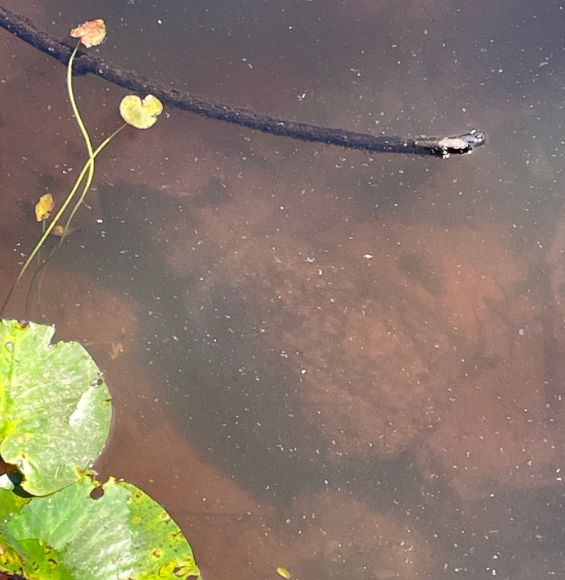
Although it is massive and apparently heavy, it is very agile and its reactions are unpredictable. It can be active at night in the southern part of its range and hibernates in the northern part.
Why is the snapping turtle dangerous?
They are considered mainly due to their aggressive behavior and powerful bite. Here are some reasons why they are considered dangerous:
- Powerful bite: Snapping turtles have strong, sharp jaws that allow them to exert great force in their bite. They can cause serious injuries to potential prey, other animals, and even humans. The bite of a snapping turtle can be strong enough to break bones.
- Aggressive behavior: These are known for their territorial and aggressive behavior. If they feel threatened or their space is invaded, they are likely to attack to defend themselves.
- Not afraid of water: Unlike many other turtles that may retreat into their shells as a defense mechanism, snapping turtles are less likely to do so. Instead, they rely on their powerful bite and aggressive attitude to confront potential predators.
- Predatory predisposition: As mentioned, snapping turtles share the ability to prey on other animals with larger turtles like the alligator snapping turtle. This means they are active hunters and can pose a threat to other animal species in their habitat, including fish, amphibians, birds, and even small mammals.
Despite what some sources say, they are not venomous turtles.
In general, snapping turtles do not pose a direct danger to humans in their natural environment unless provoked or threatened. If left alone and not disturbed, they are usually calm animals and will prefer to avoid contact with humans.
How long does a snapping turtle live?
There are few reliable records on the longevity of the snapping turtle in its natural habitat, although it is estimated they can live up to 30 years. However, in captivity, due to the lack of predators and proper care, their life expectancy increases significantly. Therefore, it is common to find individuals that surpass 40 years in captivity.
How big is the snapping turtle?
This turtle species, the snapping turtle or serpentine turtle (Chelydra serpentina), is characterized by a robust and compact body, and can reach up to 55 cm in length and weigh up to 60 kg. It is a large turtle, ranking among the largest freshwater turtles. Its bone structure is designed to support its weight and provide great strength and resistance, allowing it to move easily through its natural environment.
What does the snapping turtle eat?
This turtle is omnivorous, although it leans more towards a carnivorous diet. It feeds on insects, crustaceans, mollusks, worms, fish, amphibians, snakes, and small mammals. Although it drowns birds by grabbing them by the legs while they swim, it does not eat other turtles. It also feeds on plants, algae, and sponges found in freshwater.
Reproduction
The mating season runs from April to November. During copulation, the male and female swim facing each other, although the courtship is not very elaborate. Egg-laying occurs between May and September, and the nest is quite large, with a narrow entrance leading to a wider chamber. Each clutch can contain between 10 and 83 eggs, with an average of 30.
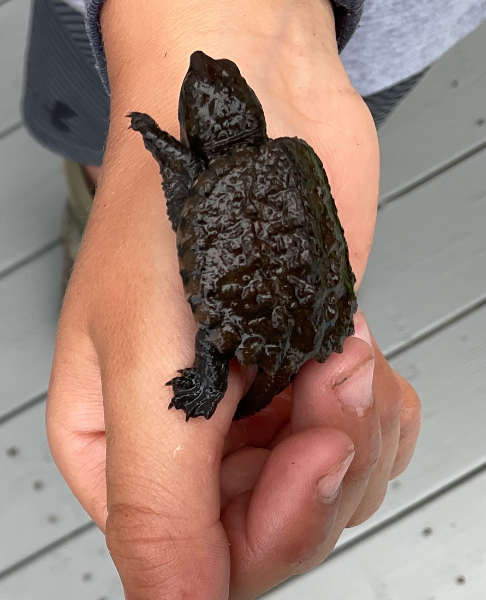
The eggs are oval-shaped, hard, and about 3 cm in diameter. Incubation can last between 55 and 125 days, depending on environmental conditions. Hatchlings usually emerge from late August to October.
Conservation status
The snapping turtle species is highly adaptable and common in its natural habitat. However, they are often captured by humans for two main reasons: their appearance and relative danger, and their meat is consumed. Historically, indigenous people used them to prepare broths and soups, especially in Louisiana and Florida.
The turtle's eggs are eaten fried, as they do not harden when boiled in hot water. In Florida, thousands of C. serpentina shells have been used to fence fields and are sold dried in souvenir shops. Urbanization has resulted in the disappearance of many populations, and the species is also exported to other Western countries.
Unfortunately, buyers of these turtles' hatchlings, which weigh only about 20 grams, release them into the wild once they become large and dangerous, which often results in the destruction of local wildlife. C. serpentina is a superpredator. It is important to remember that it is a
Snapping Turtle Video
