
Greek Tortoise
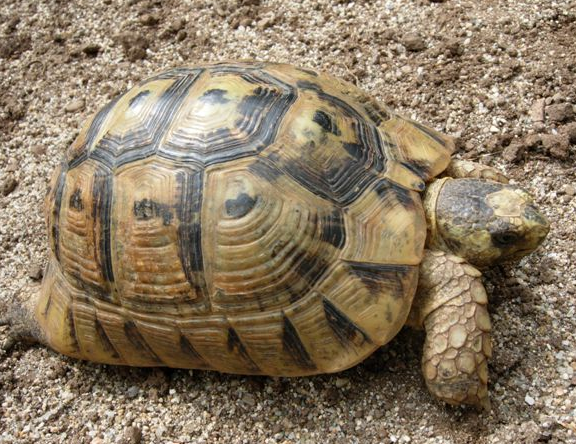
The Moorish tortoise (Testudo graeca) is a species of land tortoise found in various regions of Europe and Africa. It is one of the most popular tortoise species kept as pets worldwide. It is also known as the Moroccan tortoise or Moorish land tortoise. We have already discussed the Mediterranean tortoise, which has dry and rocky habits, lives in nearby areas, and shows some similarities with the Moorish tortoise.
Distribution of the Moorish tortoise
This species of tortoise is found in North Africa, from Morocco to the northwest of Libya. It can also be seen inhabiting southern Spain and the Balearic Islands, Sardinia, and Sicily.
Characteristics of the Moorish tortoise
This land tortoise is distinguished by several unique features. It has spurs on the back of its thighs and lacks a claw at the tip of its tail. The supracaudal scute (above the tail) is not divided, and its plastron is yellowish to cream-colored, with irregular or barely visible black spots instead of regular black lateral bands. Its shell is highly domed, yellowish to greenish with black markings, which often fade with age. Its head also has black and yellow spots. In females, the posterior lobe of the plastron is often very flexible, which facilitates egg-laying.
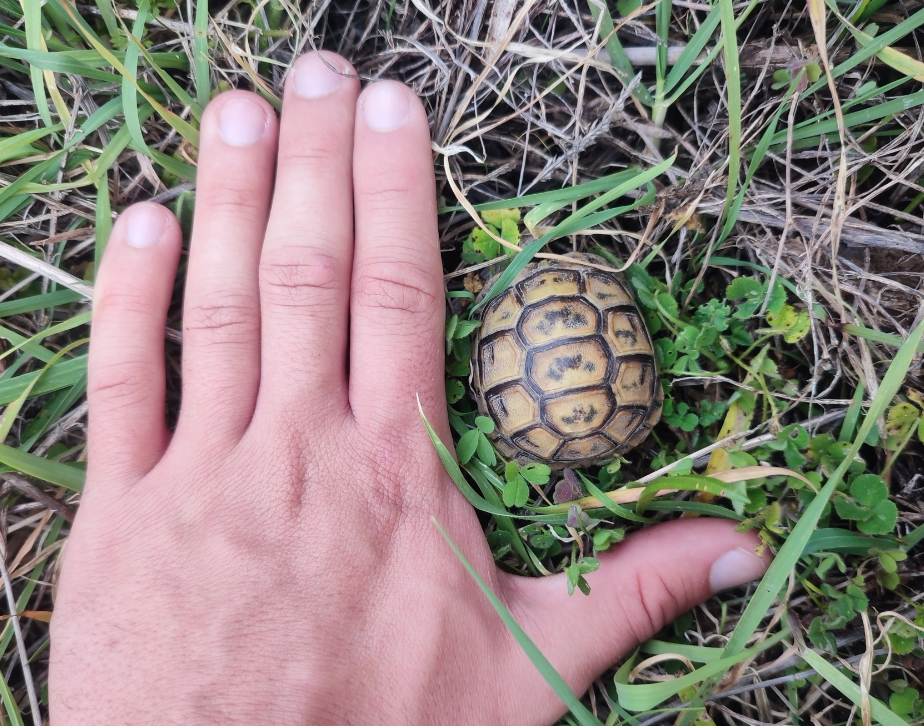
The baby Moorish tortoise is usually grayish in color at birth and quickly develops a more contrasting dark yellow coloration. The small spurs behind their thighs, characteristic of the species, can already be seen. When they become very old, they often lose their scutes and may have a white shell, which is not a problem.
These tortoises are accustomed to a warm and dry climate, so the trade and trafficking of the species across Europe often causes them chronic lung diseases that can lead to rapid death. These diseases can also be transmitted to other species, such as Mediterranean tortoises.
Habits of the Moorish tortoise
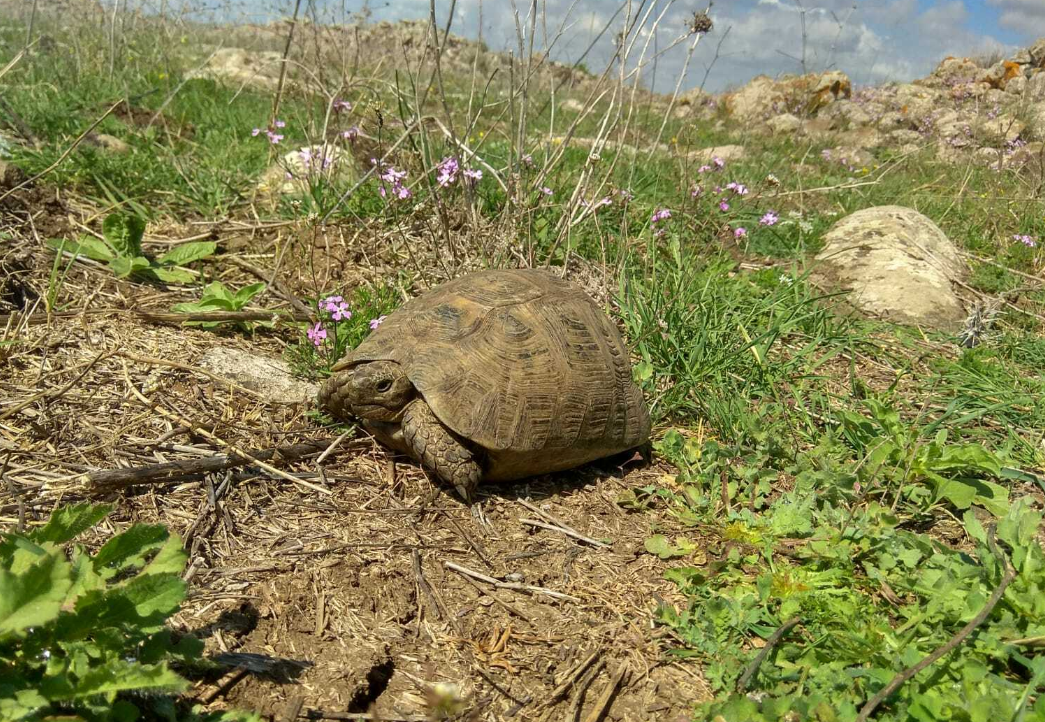
This species of land tortoise lives in arid places and feeds on thistles and plant debris. Some populations of Moorish tortoises hibernate in high-altitude areas. The tortoises aestivate during the hot months and hide under bushes or in cavities. Males are aggressive and fight fiercely during the breeding season. Breeding occurs in spring and after the rare autumn rains.
Subspecies of the Moorish tortoise
We analyze six subspecies within this genus of Testudo graeca.
Testudo graeca graeca.
Testudo graeca cyrenaica. Found in the Cyrenaica Peninsula up to Libya, and does not exceed 20 cm in length. This subspecies is distinguished by having very slender forelimbs, a laterally narrow shell, and an irregular contact area between the marginals and costals.
Testudo graeca marokkensis. Located in central Morocco, it has a lower shell with more abundant dark lines than the nominal subspecies.
Testudo graeca lamberti. From northwest Morocco, it has very well-developed spurs behind the thighs and curved posterior marginals, including a dark coloration with fine diffuse lines.
Testudo graeca nabeulensis. Found in Tunisia and western Libya, it is distinguished by its elegant appearance, a highly domed carapace, and a fifth vertebral with a "tarantula"-shaped pattern.
Testudo graeca soussensis. Lives in southwest Morocco and is distinguished by its relatively long interpectoral suture and the absence of spots in the areolar area of the vertebrals and marginals in juveniles, although females can grow up to 25 cm.
The Moorish tortoise in Spain
In Spain, the subspecies Testudo graeca graeca can be found, possibly descended from tortoises originally from North Africa that were introduced to the peninsula several centuries ago. Although the theory has not been conclusively confirmed, these tortoises make up one of the four continental species in our country.
The distribution of the Moorish tortoise in Spain is mainly concentrated in three distinct areas:
- An isolated population nucleus in Doñana (Huelva).
- The most densely populated region covers part of Almería and southern Murcia. These populations are not connected to each other, and the density of tortoises varies significantly at different inhabited points.
- In the Balearic Islands, they can be found in the west of Mallorca. Although they were present in Formentera and Ibiza until the last century, they are now considered extinct (ANDREU, DÍAZ-PANIAGUA & KELLER).
In recent decades, there has been a significant decline in tortoise populations in Spain.
How long does the Moorish tortoise live?
The life expectancy of the Moorish tortoise can be quite long, reaching up to 50 years in captivity, although one writer mentions that a tortoise of this species in England lived up to 120 years. The Moorish tortoise has a much lower life expectancy in the wild, around 20 years.
How big does the Moorish tortoise get?
This tortoise is medium-sized, reaching a maximum length of about 30 centimeters. Although males are smaller than females (150 to 180 mm for males, compared to 300 mm for females), it is common to see very small males mating with larger females.
What can the Moorish tortoise eat?
The diet of the Moorish tortoise is omnivorous and includes a wide variety of plants and animals, including grasses, flowers, fruits, insects, and small vertebrates. It is a very hardy species adapted to extreme environments, so it can be found in desert and semi-arid areas.
Care for the Moorish tortoise
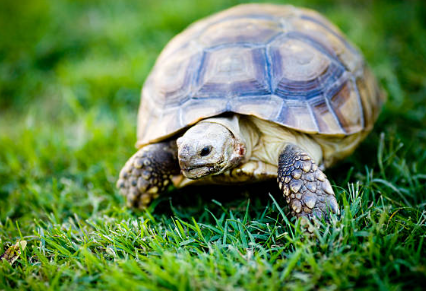
To keep the Moorish tortoise in good condition, it is advisable to have a garden where they can be kept in semi-freedom, which is obviously the best way, with both shaded and sunny areas.
The size of the outdoor enclosure is variable, depending on the number of individuals. The most appropriate ratio is one male for every two females.
The type of vegetation used to create an appropriate environment should be characteristic of the natural habitat of these tortoises, such as chamomile, rosemary, thyme, and lavender. A shaded area should be created.
The housing or terrarium is one of the most important factors for our animals to grow up healthy.
It is also necessary for the tortoises to have a bathing area, where they can cool off or drink during the hottest hours of the day.
Terrarium
We can keep these tortoises in indoor terrariums, but we must choose the lighting, heat source, and terrarium size correctly. They are cold-blooded animals that need an external heat source, such as light and heat lamps, electric blankets, or heating cables.
The size of the terrarium should be proportional to the size of the animals, but it is recommended to be at least two meters long for adult animals.
The air temperature should be kept between 25 and 32 degrees during the day and around 20 degrees at night, and the terrarium humidity should be controlled between 50 and 70%.
Substrate
The substrate can vary, but those that produce dust or have a small grain size should be avoided.

- Producto para tu mascota
- Sencillo de usar
- Material de calidad
Lighting
The lighting in the terrarium is important for vitamin D production, so a fluorescent tube or bulb with ultraviolet emission should be used.

- Ideal para todos los reptiles tropicales y subtropicales
- Niveles óptimos de UVB
- Efectivo de hasta 40 cm (15")
- Suministra los necesarios rayos UVB para el metabolismo óptimo del calcio
- Los rayos UVA estimulan el apetito, actividad y comportamiento reproductivo

Water dish
Clean water should also be provided in a container that is changed daily.

- Materiales premium - Comedero reptiles hechas de plástico de alta calidad, seguro y duradero, antideslizante y resistente al desgaste
- Función 2 en 1 - Combinación de botella de agua automática y platos para terrario, la base puede contener agua y comida al mismo tiempo
- Base resistente - Bebedero tortuga terrestres tierra llenar agua automáticamente el platos plano, será estable y no se volcará. Base redonda y lisa, resistente a caídas y no se rompe
- Sentido práctico - Cuando está de vacaciones y cuando está ocupado, 2 en 1 bebedero tortuga puede proporcionar agua para lagartos, gecos, serpientes, escorpiones y animales pequeños
- Fácil de limpiar - Tazón para reptiles y botella de agua extraíble, enjuague regularmente con agua y cepille, puede mantenerlo limpio y ordenado
Feeding the Moorish tortoise
Its diet in the wild includes more than 90 different plant species, consuming leaves, flowers, young shoots, and fruits from several of them. They feed on up to 88 different species, with grasses being the most consumed, followed by legumes, composites, and rushes. The feces of these tortoises contain seeds from up to 34 different species, indicating their crucial role in seed dispersal, which contributes to the spread of many local plants.
Reproduction of the Moorish tortoise
The mating season occurs at the beginning of spring or after the rare autumn rains. During courtship, the male chases the female, bites her legs or neck hard, circles her to immobilize her, and finally mounts her back. At that moment, small grunts can be heard from the male. The species usually lays eggs from April to June, with three clutches being common and a record of five for a single female. Each clutch consists of up to a dozen eggs, with an average of six or seven eggs per female (10-12 g per egg).
Conservation status of the Moorish tortoise
Despite its popularity as a pet, the Moorish tortoise is a protected species in many countries, and its capture and trade are regulated by laws and international treaties. It is important to remember that tortoises require special care and a suitable environment to live, so they should not be acquired as pets without proper planning and preparation.
Testudo graeca has been exploited and transported by humans since ancient times, used in ancient Greece to wedge amphorae on ships and later found in curiosity collections throughout the Western world. During the colonial wars, soldiers brought them to European countries, and they were sold in fish markets and pet shops, which led to the reduction of wild populations to just a few individuals. Today, they are still collected and sold in the markets of the entire Maghreb, and their protection depends on study and conservation programs, curbing sales in the countries of origin, and ongoing information efforts.
There is a risk that these tortoises end up in suburban gardens in regions with a climate that is too humid, which reduces their life expectancy. The sale of these tortoises has also created an interest in land tortoises and having garden tortoises, which is detrimental to all tortoise species in general.
The species is listed in CITES Appendix II and Annex C1 of the European Community, and is prohibited in Spain.
Accessories for Land Tortoises
Other types of land tortoises
There are several species of land tortoises around the world, each with distinctive characteristics:
Argentine Tortoise
Indian Star Tortoise
Red-Footed Tortoise
Leopard Tortoise
Galápagos Tortoise
Hermann's Tortoise