
Galápagos Tortoise
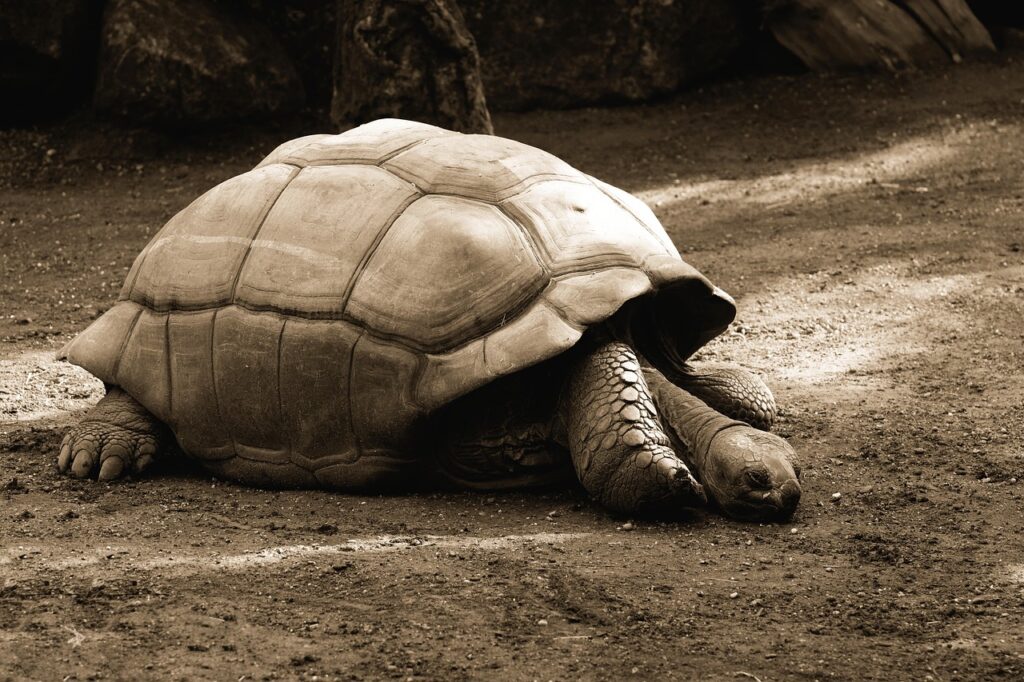
The Galápagos tortoise (Chelonoidis nigra) is a group of land tortoises that inhabit the Galápagos Islands, an archipelago located in the Pacific Ocean off the coast of Ecuador. These tortoises are known for their longevity and large size, reaching over 400 kg in weight and living more than 100 years.
The Galápagos tortoises are an emblematic species of the archipelago and have been studied for a long time by scientists due to their importance for understanding evolution and biodiversity. Charles Darwin, the famous British naturalist, visited the islands in 1835 and studied these tortoises, which influenced his theory of evolution by natural selection.
Today, only two species of insular giant tortoises exist: the Aldabra tortoise (Dipsochelys elephantina) and the Galápagos tortoise (Chelonoidis nigra), after numerous species from the Indian Ocean disappeared. Despite living in different places, these species share many similarities and a common past. They show significant morphological differences.
Distribution of the Galápagos tortoise
This tortoise, formerly known as Geochelone elephantopus, is found exclusively in the Galápagos archipelago, which is located 1,000 kilometers off the coast of Ecuador and is known as the origin of the famous Galápagos tortoises. The arrival of these Chelonoidis to the Pacific islands is due to their migration from nearby continental masses millions of years ago, reaching the islands via floating rafts or possibly being transported during hurricanes.
Characteristics of the Galápagos tortoise
The Chelonoidis nigra lacks a nuchal scute and its shell varies in shape depending on the island and subspecies, while its neck is long and slender. Its color is black with fine orange sutures, and its walk is characteristic: with the carapace forward, neck and head stretched out, legs lifted, and a wide stride. In contrast, the Aldabra tortoise has a rounded and friendly head compared to the triangular and gaunt face of Chelonoidis nigra.
Subspecies of the Galápagos tortoise
There are nine subspecies of the species Chelonoidis nigra, which differ according to the island of the Galápagos archipelago where they live. Some of these subspecies, unfortunately, have disappeared today.
The subspecies are as follows:
- Chelonoidis nigra: It has a very regular and fairly flat dome, with the front part slightly raised. It was found on Floreana Island, but is now extinct.
- Chelonoidis nigra abingdonii (Gunther, 1878): Its carapace is raised at the front and flat at the back. It inhabits Pinta Island, but only one male remains, named George, who is at the Darwin Center in Santa Cruz.
- Chelonoidis nigra beckii (Rothschild, 1901): Its carapace is moderately raised at the front. It is found in the north of Isabela Island, on Wolf Volcano, and its population ranges between 1,000 and 2,000 individuals.
- Chelonoidis nigra chathamensis (Vandenburg, 1907): The shape is very rounded and classic. It inhabits the southwest and center of San Cristóbal Island, and its population is between 500 and 700 individuals.
- Chelonoidis nigra darwini (Vandenburg, 1907): The shell is high, slightly raised at the front and very raised at the back. It inhabits San Salvador Island, and its population is between 500 and 700 individuals.
- Chelonoidis nigra duncanensis (Garman, 1917): With a very flat cylindrical shape, but horizontal and very narrow at the front, towards the first vertebral scute. It inhabits Pinzón Island, and its population ranges between 150 and 200 individuals.
- Chelonoidis nigra hoodensis (Vandenburg, 1907): It has a flattened cylindrical shape with a horizontal front part. It is found on Española Island and has between 20 and 30 specimens.
- Chelonoidis nigra phantastica (Vandenburg, 1907): Tortoise very flattened at the front. Extinct.
- Chelonoidis nigra porteri (Rothschild, 1903): It has a flattened dome and is found in the south of Santa Cruz, with an estimated population of 2,000 to 3,000 individuals.
- Chelonoidis nigra vicina (Gunther, 1875): The dome shape with the front part raised, especially pronounced in males. It is found on Isabela, on the Alcedo and Iguana volcanoes, Cerro Azul and Darwin, as well as in the Tagus coves. Its population is estimated to range between 3,000 and 5,000 individuals.
Habits of the Galápagos tortoise
Each tortoise subspecies has specific habits due to the ecosystem and microclimate in which it lives. Some tortoises inhabit dry, grassy areas, even at the edge of the sea, while others are found on volcanoes at intermediate altitudes, in humid calderas, or in rocky and arid zones. At this equatorial latitude, the presence of the ocean moderates temperatures, which remain quite stable throughout the year, with a relatively short wet period in August and September.
The adult tortoise species can survive in arid habitats without eating or drinking for weeks. Charles Darwin had previously observed their ability to withstand dehydration. Sometimes, adults make long migrations to find known water sources, creating well-known trails that they follow in the future. They can absorb up to 15% of their body weight in water at one time. After staying around the water source for two or three days, they return to their usual territory.
Although the Galápagos tortoises are solitary, they may gather during migrations to water sources or to occupy narrow spaces, such as inside a volcano. They often cover themselves with soil to cool off, rolling in a soft dirt hollow, which can help rid them of parasites. It is also common to see males allowing finches to clean them. These males remain motionless with their necks and legs raised while the finches peck and "groom" them.
The species has also developed a unique hunting technique: the tortoise stands up on its hind legs and lets a bird get under its shell before dropping down to crush and eat it.
How long does a Galápagos tortoise live?
The Galápagos tortoise can live up to 150 years.
How big is the Galápagos tortoise?
Although the giant Galápagos tortoises can reach a record weight of 400 kg in captivity, the Aldabra tortoise has recorded a maximum weight of 310 kg in the wild. There is sexual dimorphism in Galápagos tortoises, with males being three times larger than females and having an impressive plastron concavity that can exceed 12 cm.
What does the Galápagos tortoise eat?
They are omnivorous tortoises. Although they prefer vegetables, especially cacti, they also consume goat carcasses, feces, and other organic waste.
They can also eat moss, fungi, insects, and carrion. The diet of the tortoises may vary depending on the island where they live and the climatic and food conditions available on each one.
Reproduction of the Galápagos tortoise
Mating occurs during the wet season and towards the end of it in the case of copulation. During this process, males intensely harass females, surrounding them and trying to nibble their legs. Then, they place their broad legs on the front part of the female's body, which involves a risk of crushing. The loud bellowing of the animals can be heard from several meters away, but the copulation itself is quite brief. Afterwards, egg laying takes place.
Egg laying occurs in open, sunny areas that are consistent each season, which can result in the destruction of previous clutches. The eggs are spherical and have a diameter of about 5 cm. Each nest is expected to have an average of 30 eggs. The incubation period lasts from 80 to 100 days. Juveniles weigh about 60 g and experience rapid growth, reaching a weight of 1 kg after the first year.
Conservation status of the Galápagos tortoise
Some subspecies have been eradicated, while others are threatened due to the introduction of predators such as rats, pigs, and dogs, which have already caused havoc. Goats are an additional threat as they destroy all plant sustenance, which negatively affects the tortoises. Ecuadorians who settle in the archipelago, especially in Santa Cruz and Isabela, come into conflict with the tortoises when they clear land for crops. This has led to dozens of tortoises being found killed by farmers, and fires also occur that kill tortoises, especially in southern Isabela.
The Darwin Center in Santa Cruz is in charge of conserving these tortoises, but each subspecies represents a particular case. On the other islands, such as Isabela, the eradication of exotic animals continues.
It is forbidden to touch, move, or take tortoises. Although these tortoises are found in zoos and collections around the world, breeding centers cannot be used for reintroductions because the subspecies have been mixed. Illegal collection of tortoises on the islands and their export to distant places should be prevented. Despite all this, tortoises are still illegally taken on boats to be sold.
Other types of land tortoises
There are several species of land tortoises around the world, each with distinctive characteristics:
Argentine Tortoise
Indian Star Tortoise
Red-Footed Tortoise
Leopard Tortoise
Greek Tortoise
Hermann's Tortoise