
Loggerhead Sea Turtle
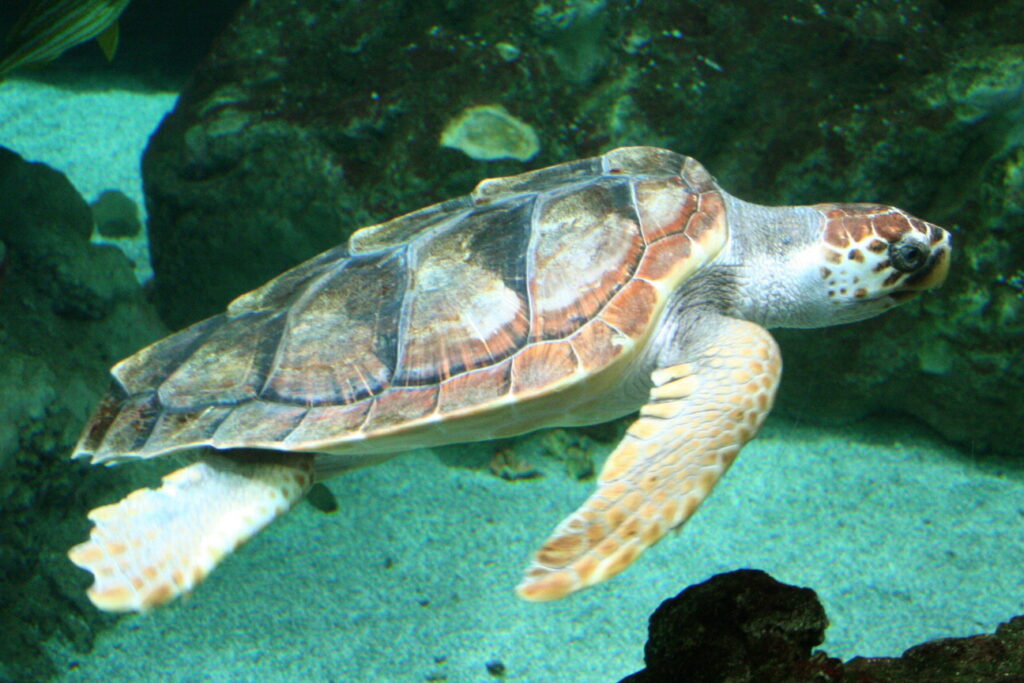
The Loggerhead Turtle (Caretta caretta), also known as the Atlantic hawksbill turtle, is a large sea turtle that is threatened and endangered. It is also called babaua turtle or caretta turtle.
Distribution of the Loggerhead Turtle
The loggerhead turtle (Caretta caretta) is the second most common sea turtle species worldwide after the green turtle (Chelonia mydas). It mainly inhabits tropical and subtropical waters, but can also occasionally be found in colder waters, such as southern Norway, Canada, Russia, and the United States. Its range extends from 70º north latitude to 35º south latitude, reaching as far as the Río de la Plata in Argentina. This species appears to be absent from parts of the Pacific Ocean and northern South America.
The loggerhead turtle in the Canary Islands
The loggerhead turtle is a species of sea turtle that can be found along the coasts of the Canary Islands, although its presence is limited. In recent decades, efforts have been made to protect and conserve loggerhead turtle populations in the area, including research, monitoring, and environmental education programs. The main threats to this species in the Canary Islands are accidental fishing, maritime traffic, and pollution. Organizations must continue working on the conservation of this species and the preservation of its habitat along the Canary coasts.
Characteristics of the Loggerhead Turtle
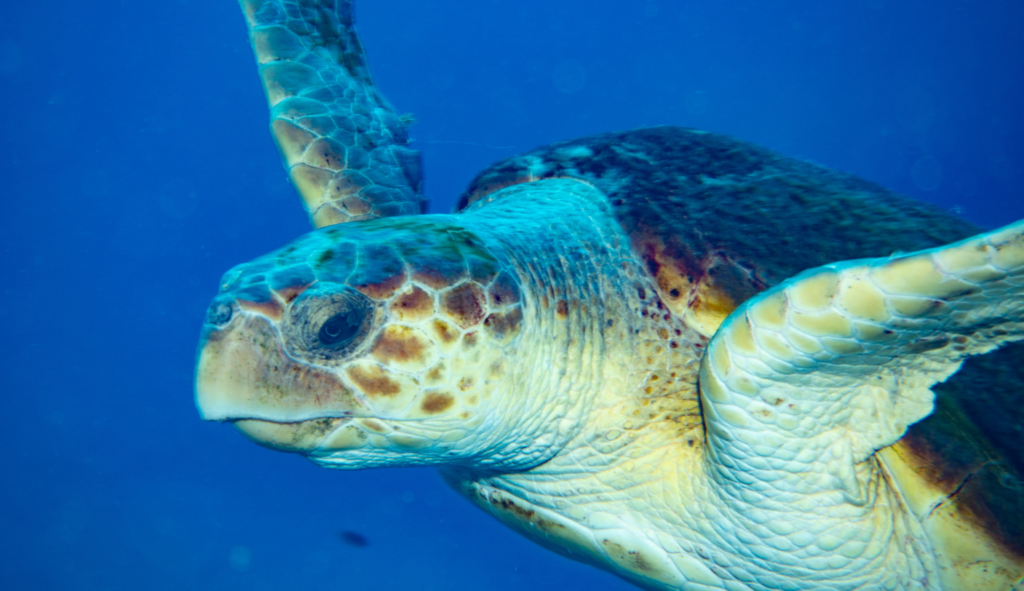
The carapace of this species is heart-shaped and has a very pronounced vertebral keel in juveniles, which becomes more rounded in adults, although it remains visible in the first two vertebrae. The carapace has five pairs of costal scutes, with the first ones in contact with the nuchal, while there are 12 to 13 marginals on each side, which can vary from 11 to 15. Unlike other chelonians, the edge of the marginals is serrated in juveniles, but flattens with age, and in older individuals is only slightly raised on the sides. Its color can range from dark brown to yellow-orange, or chocolate, and the edge of the marginals is highlighted in yellow.
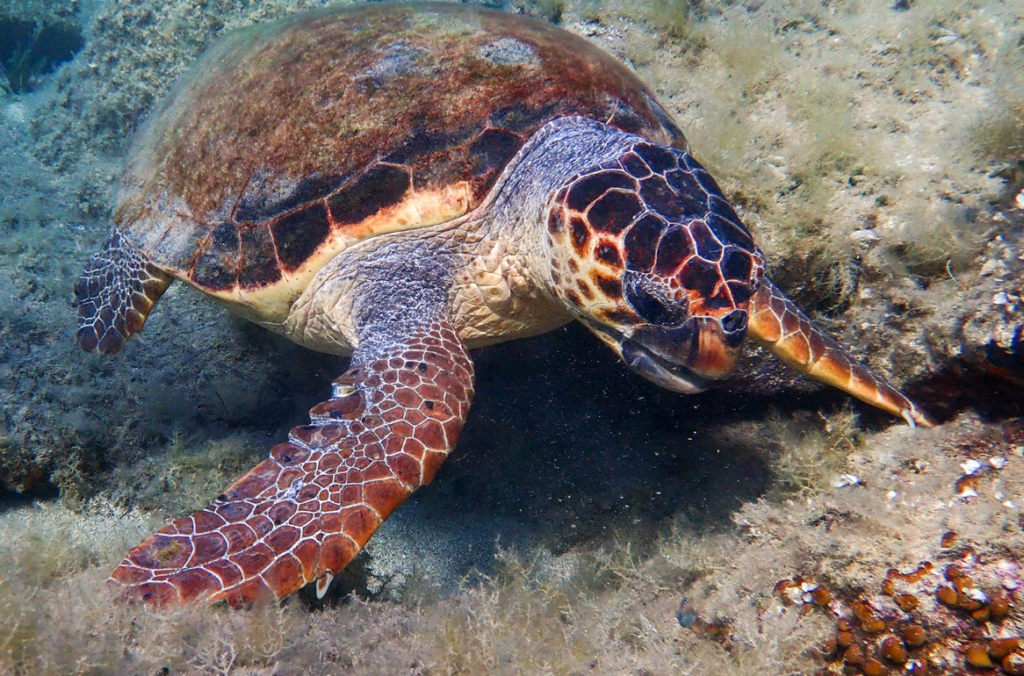
The plastron, on the other hand, is light brownish-yellow or even orange, like the bridges which are made up of three large inframarginal plates, without pores. In adults, the plastron is smooth, while juveniles have two longitudinal keels. The head of this species is very large, which led to its English name. It is rounded and has a pronounced, but not serrated, horny beak, and features four or five prefrontal scutes, as well as a large frontoparietal scale on top of the head and three large postocular scales on the sides. The nostrils are slightly prominent. The head is brown on top and lighter underneath, turning brownish-orange and even yellow, as do the neck and legs.
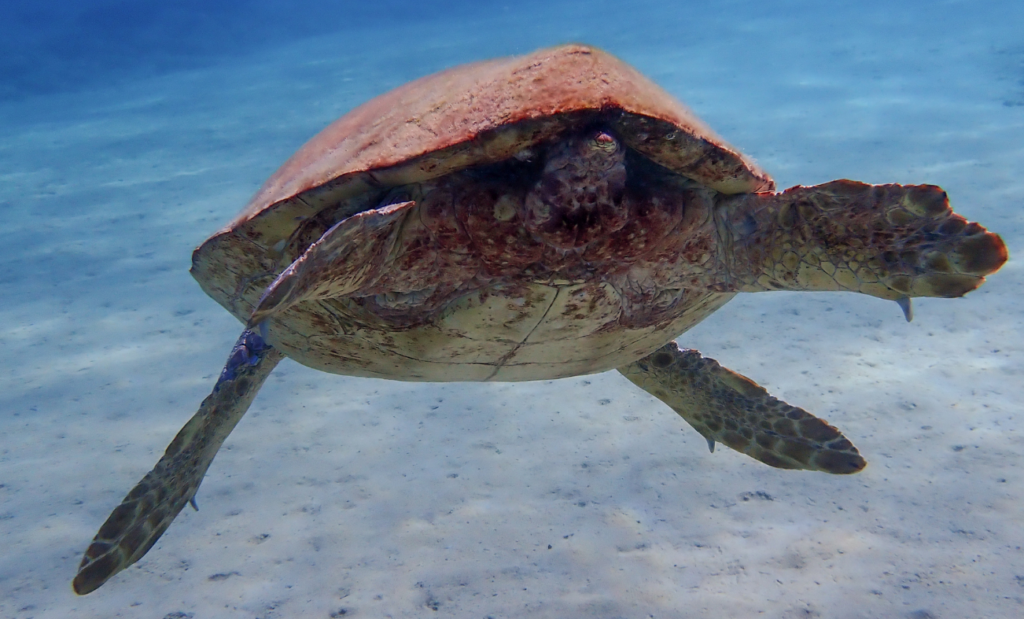
The legs of this species are particularly well adapted for swimming and have two claws. The front legs are covered with large plates that surround a group of smaller scales in the center of the flipper. In males, the tail appendage is noticeably larger and longer than in females.
This species has a distinctive heart-shaped carapace with a prominent vertebral keel in juveniles, a large head with a pronounced horny beak, and legs well adapted for swimming.
Habits of the Loggerhead Turtle
The species is found mainly along the coasts and is not very pelagic (species that live in midwater or near the surface), but it also has great migratory potential and moves to beaches to nest. It can maintain an internal temperature higher than that of the water thanks to slight muscular activity and natural insulation, which allows it to live in cold waters. During winter, it can enter a state of torpor and remain motionless at the bottom of the water for a while.
The turtle swims slowly and gracefully, but is also capable of surprising bursts of speed, as divers know well. Its temperament can be difficult and it may bite if disturbed. There is video evidence of how it has defended itself from a tiger shark by biting its gills and causing the shark to release its prey. Its jaws are powerful and can easily crush the shell of a crab, a lobster, or a large mollusk.
How long does the loggerhead turtle live?
The loggerhead turtle lives for over 65 years in the wild. In captivity, it can exceed 100 years of age.
How big is the turtle?
It is a large turtle, reaching an average of 120 cm and in exceptional cases up to 200 cm. It weighs around 130 kg, although there are reports of much heavier individuals.
What does the loggerhead turtle eat?
It is mainly carnivorous and feeds on crustaceans, mollusks, echinoderms, fish, but also on aquatic plants and algae.
Reproduction of the Loggerhead Turtle
Mating occurs at the sea surface, and the male clings to the female's carapace with the claws of his front legs. Sexual maturity appears to be very early, at four years old and with a length of about 60 cm for the first reproductions. Egg-laying occurs most often at dusk or during the night, when the tide is high, on the fine sand of beaches in temperate and subtropical regions. The eggs develop in spring and early summer.
They have between three and seven clutches per season, each at intervals of about fifteen days. Some females only lay eggs every two or three years. During egg-laying, turtles deposit around a hundred eggs that are round and measure 35 to 49 mm in diameter, with a maximum of 150 eggs. Females often show fear during nest excavation and may interrupt laying and return to the sea if disturbed.
The egg-laying process is one of the fastest among sea turtles and usually lasts from 10 to 20 minutes. The complete process, from laying to returning to the sea, takes less than 60 minutes in many cases. The incubation of the eggs lasts from 46 to 71 days, depending on the temperature. Temperature also influences the sex of the baby loggerhead turtle. If the eggs are kept at a temperature above 32º C during the first weeks of incubation, only females will hatch, while if the temperature is below 28º C, only males will hatch.
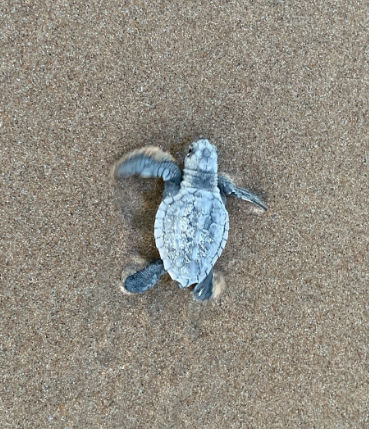
The sea turtle hatchlings have a brown to grayish, highly keeled carapace when they are born. They measure about 55 mm and escape from numerous predators, such as crabs, birds, mammals, fish, and sharks. They swim frantically for several days until they reach an area invaded by floating algae, such as sargassum, where they can camouflage themselves. Then, they begin to grow rapidly by feeding on zooplankton.
Conservation status of the Loggerhead Turtle
The loggerhead turtle nests in urbanized and tourist areas that are often degraded or destroyed. The species has been exploited for its meat and shell, and continues to be hunted and fished. Loggerhead turtles fall victim to drift nets and shrimp trawlers, and measures such as exclusion devices are needed to allow turtles to escape. Although there are conservation programs, few countries enforce the use of exclusion devices. Satellite radio transmitters are used to study the migratory routes of loggerhead turtles. The species is protected by the Bonn Convention and CITES, and is listed in Appendix I.
