
Malaclemys terrapin
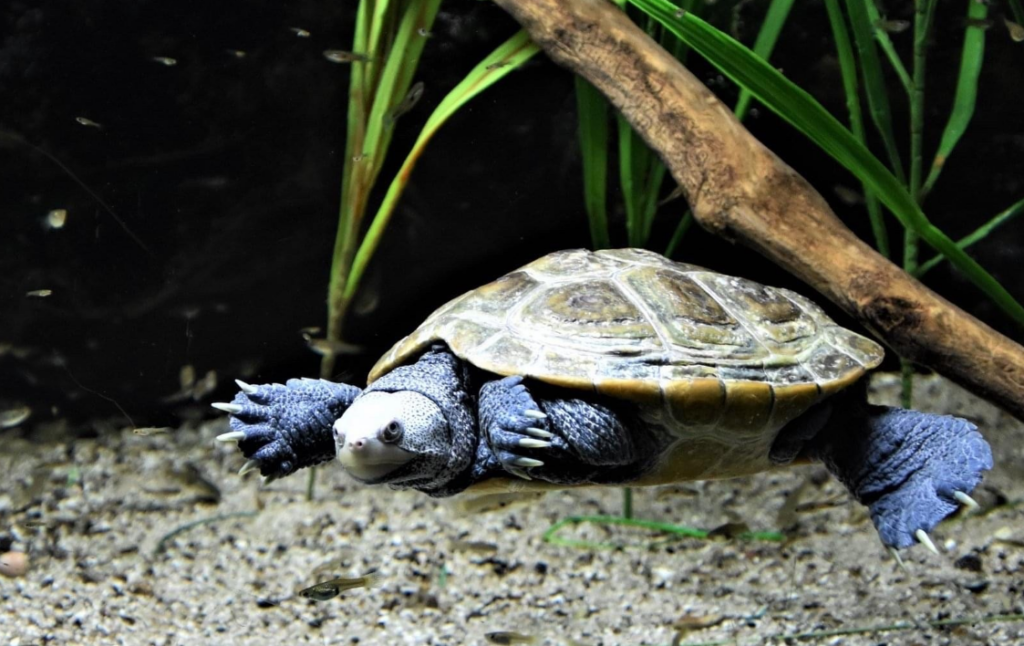
The Malaclemys terrapin turtle, commonly known as the diamondback terrapin, is a species of aquatic turtle that inhabits the Atlantic coast of North America. Its name comes from the diamond-shaped scutes on its shell, which make the diamondback terrapin easily recognizable.
Distribution
The Malaclemys terrapin, or diamondback terrapin, is a species endemic to the Atlantic coast of North America and is found only in the United States. Its habitat extends along a narrow coastal strip on the Atlantic side, from Cape Cod in Massachusetts in the north, down to Texas in the southwest, passing through the Florida Keys in the south.
Although its geographic range is relatively limited, the diamondback terrapin has great ecological and cultural importance in its distribution area. It is an iconic species of the North American Atlantic coast.
Characteristics
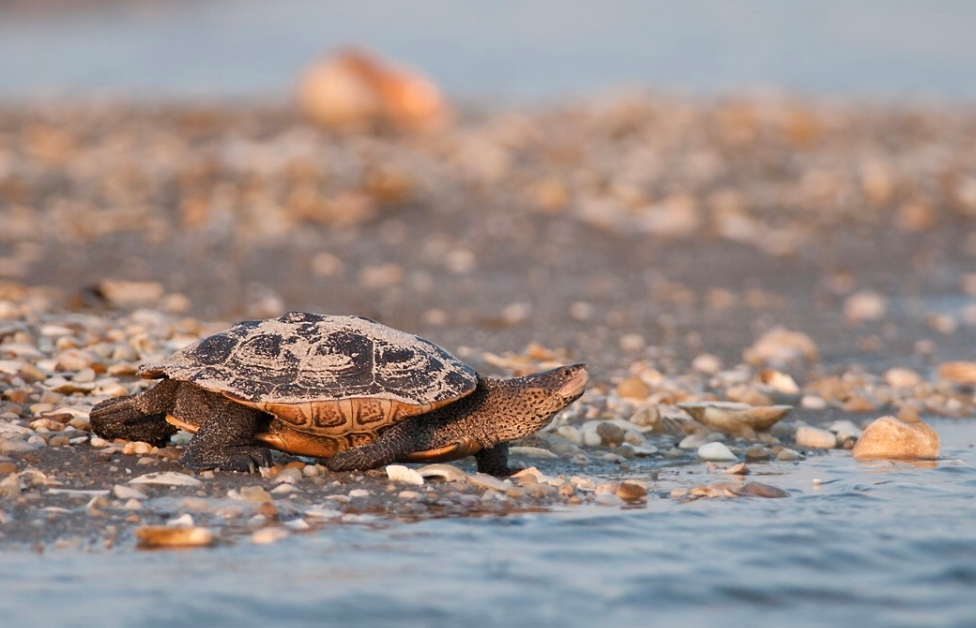
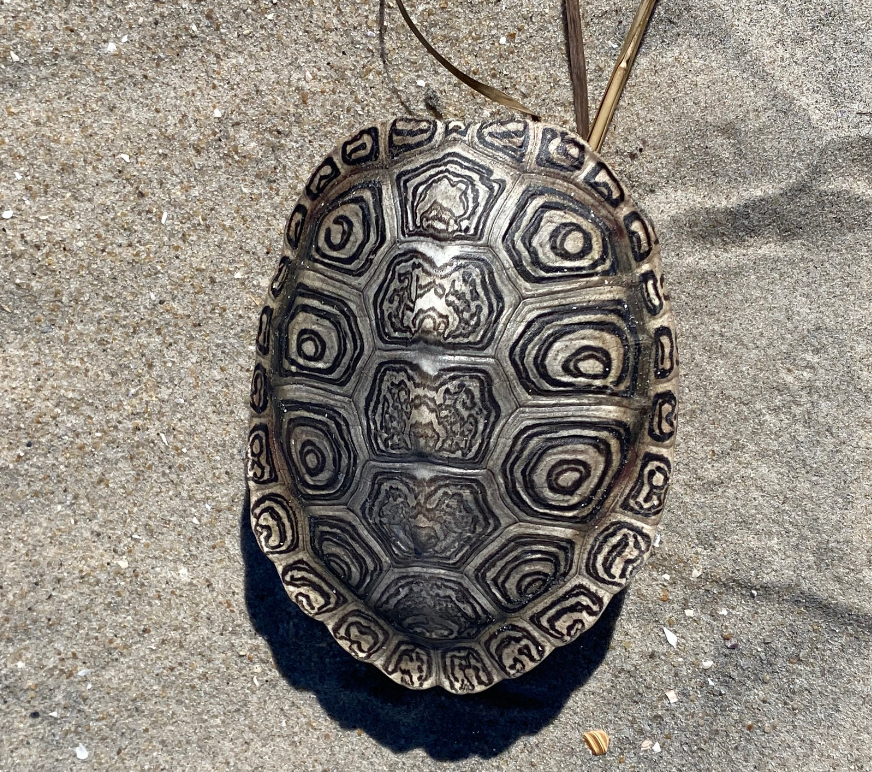
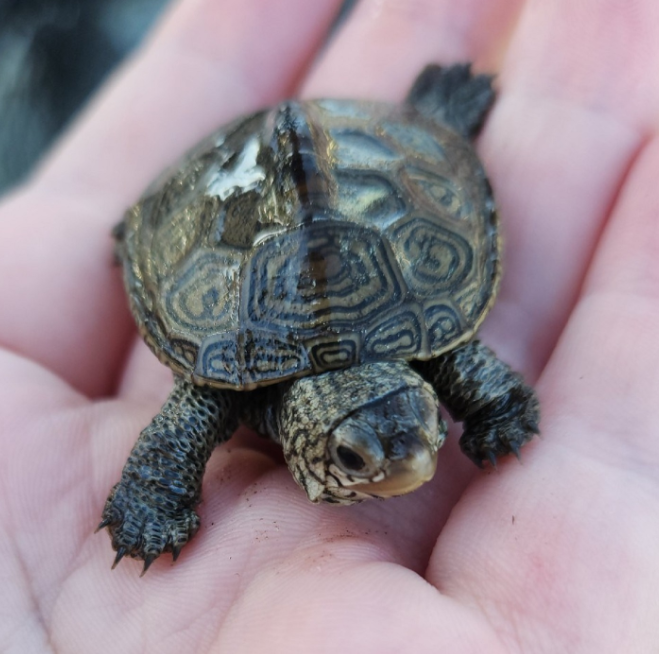
It is a very striking and beautiful turtle. It is distinguished by the pronounced ridges on each scute of its carapace, from which its diamond name comes. Its carapace widens behind the bridges and narrows towards the back, and it has a strong keel on the vertebral scutes, which are always wider than they are long. The overall color varies depending on the subspecies and can range from gray to light brown and black.
The plastron of the diamondback terrapin is yellow to greenish, with irregular dark spots that are more or less pronounced. The bridges are wide and strong, and the head is rather short and narrow in males and wider in females. The eyes are large, black, and always protruding. The skin on the head, neck, and legs is characterized by a gray or whitish tone and decorated with dark blackish spots or dots. The jaws are very light, often yellowish, and sometimes with a black tip on the chin.
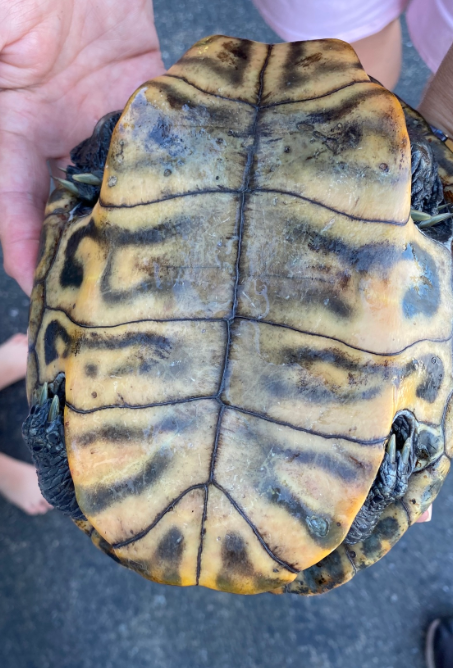
There are great color variations in this species, and juveniles are lighter than adults.
Subspecies
There are seven subspecies of the Malaclemys terrapin species:
Malaclemys terrapin centrata
The Carolina diamondback terrapin, which is found between Cape Hatteras and northern Florida. The sides of its carapace are parallel and it lacks tubercles on the vertebral keel, and the rear marginals are curved upwards.
Malaclemys terrapin littoralis
Texas diamondback terrapin, which inhabits from western Louisiana to western Texas. Its carapace is quite raised and its plastron is generally whitish. The top of the head is white, while the neck and limbs are greenish gray with black spots.
Malaclemys terrapin macrospilota
Ornate diamondback terrapin, which is found from Florida Bay to Mobile Bay in Alabama. Its keel has large tubercles on the third and fourth vertebrals, and the center of the scutes is always lighter with yellow to orange tones.
Malaclemys terrapin pileata
Mississippi diamondback terrapin, which is found from Mobile Bay to western Louisiana. Its keel has tubercles only on the last three vertebrals, which are narrower and longer than in Malaclemys terrapin macrospilota. The scutes are uniformly colored without a lighter center, and all the marginals are curved upwards on the sides, while the underside is yellow to orange. The upper side of the limbs, head, and neck is dark brown or black, and the plastron is always yellow.
Malaclemys terrapin rhizophorarum
Florida Keys diamondback terrapin, which is found only in the Florida Keys. Its keel has large tubercles, and the scutes are black to brown without a lighter center. The sutures between the scutes of the plastron have a blackish coloration, and the hind limbs are gray with black stripes, while the forelimbs and neck are uniformly gray.
Malaclemys terrapin tequesta
Eastern Florida diamondback terrapin, which is found on the east coast of Florida. Its keel has prominent tubercles oriented backward, and its carapace is brown or bronze. The costals are large, and the center is often lighter than the periphery.
Malaclemys terrapin terrapin
Northern diamondback terrapin, which is found from Cape Cod to Cape Hatteras. Its carapace can vary from light brown to solid black, and its plastron can be greenish gray or almost orange. The vertebral keel does not have tubercles.
Habits
Terrapins inhabit brackish waters such as coastal marshes, estuaries, and lagoons.
Their activity varies depending on their distribution area: in the north, they hibernate from November to early May, burying themselves in the mud, often in groups. In contrast, in the south, they are active all year round and are diurnal, feeding and basking on the shore.
They seem adapted to the differences in salinity in their habitat, but when salinity exceeds 27%, they stop drinking. If they spend a long time in salt water, their rehydration time is short. When it rains, they position themselves on the water's surface and drink the layer of freshwater, which is no more than 2 mm thick. If it rains a lot, they stretch their necks and open their mouths to drink. The lacrimal glands help them eliminate excess salt accumulated in their bodies.
Terrapins are sedentary and do not move much outside their usual area.
Terrapins have a powerful jaw adapted for eating crustaceans and mollusks, as well as crabs, bivalves, marine worms, and aquatic plants. All the tissues and body fluids of this species have a higher osmotic pressure than those of other turtles, due to their significant concentrations of urea and amino acids.
How big is the Malaclemys terrapin turtle?
It is a small turtle. Females do not exceed 23 cm in length, while males reach up to 15 cm.
What does the Malaclemys terrapin turtle eat?
It feeds on fish, insects, mollusks, invertebrates, and even other turtles. Its diet consists mainly of mollusks, fish, worms, insects, and crustaceans.
In captivity, they can be fed with dry food or turtle sticks, small fish, mollusks, raw chicken meat, among others.

- sera Raffy P es el alimento complementario, que se compone de granulado flotante, cuidadosamente elaborado, para reptiles carnívoros, como las tortugas acuáticas. La composición equilibrada y sabrosa, con ingredientes animales y vegetales, que también son necesarios, se caracteriza por sus proteínas fácilmente utilizables, hidratos de carbono de fácil digestión y su alto contenido de ácidos grasos Omega. Satisface, de manera segura, las necesidades básicas de los reptiles carnívoros. Favorece su desarrollo sano y la vitalidad.
Reproduction
Males mature at 3-5 years and females at 6-8 years, when they reach a size of 9 cm and 15 cm, respectively.
In Florida, mating occurs between March and April, and in some calm channels and water arms, you can see up to one turtle per square meter. During mating, the male shakes his head in front of the female and copulation lasts about two minutes.
Females nest from April to July, often after high tide. Nests contain 4 to 18 eggs that are white and pinkish and have a leathery texture. On average, incubation lasts from 75 to 80 days, but in the north, the eggs hatch later and the diamondback terrapin hatchlings may remain underground until spring.
Conservation status
In many regions, raccoons and foxes are known to prey on diamondback terrapin nests, but there are also other species that do so, such as crabs, muskrats, and birds.
For a long time, humans have consumed this species, as its meat was considered a delicacy. In some regions, populations have disappeared, which has led to the cessation of its consumption.
Coastal urbanization, transformation of aquatic environments, and crab traps are the main causes of the sharp decline in populations. As a result, this species, the diamondback terrapin, has become very rare in many regions.
Contenido relacionado