
Leatherback Sea Turtle
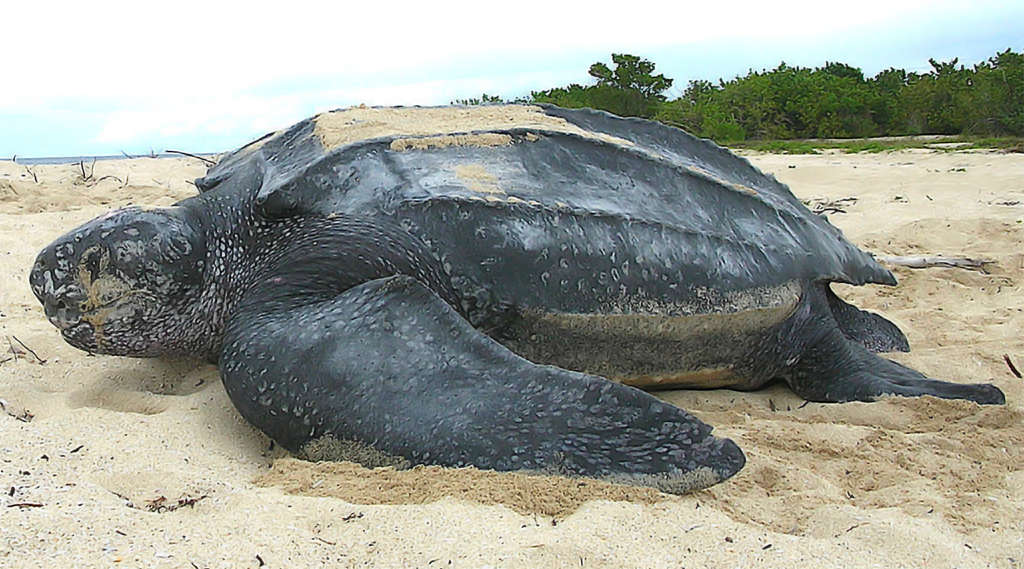
The leatherback turtle (Dermochelys coriacea), also known as the baula turtle, leathery turtle, or cana turtle, is the largest sea turtle in the world. It can grow up to 2 meters in length and weigh more than 500 kg. Its common name, "leatherback," comes from the shape of its shell, which resembles the sound box of a lute.
Distribution of the leatherback turtle
The leatherback turtle inhabits all the world's oceans and seas, including the Atlantic, Indian, and Pacific, as well as the Red, Mediterranean, and North Seas. It is capable of venturing far north and enduring the cold waters of places like Labrador, Iceland, Norway, Alaska, and the Bering Sea. It can also be found far south, in countries such as Argentina, Chile, South Africa, Australia, and New Zealand.
Characteristics of the leatherback turtle
It is the only turtle that has a pseudo-shell formed by a multitude of small osteoderms (an osteoderm is a bony plate structure found in the skin or scales of some animals) covered by a thick layer of fat. Its skin is very thin on top, smooth and shiny, resembling leather, which is the origin of its scientific name.
This turtle shows a remarkable adaptation to the marine environment. It is notable for its seven longitudinal tubercular keels, one vertebral and three lateral on each side, whose two ends define the marginal edge of the pseudo-shell.
The leatherback turtle gets its common name from the shape of its shell, which resembles the Greek stringed musical instrument called the lute.
Its skin is dark blue, dark gray, or almost black, with white spots that vary in size and number depending on the individual. The skull has a white or pink spot, which was once thought to be found only in females, but it has been shown that some males have it too. The head is large, wedge-shaped, with a short snout and an upper beak with two notches and a very developed central hook.
The legs are immense and very powerful, the tail is conical and the base is thick with a keel sometimes adorned with white tubercles. Males have a very developed caudal appendage and the plastron has three visible keels. The oral cavity is covered with long, whitish conical tubercles used to swallow food and also to retain the oxygen contained in the water.
Habits of the leatherback turtle
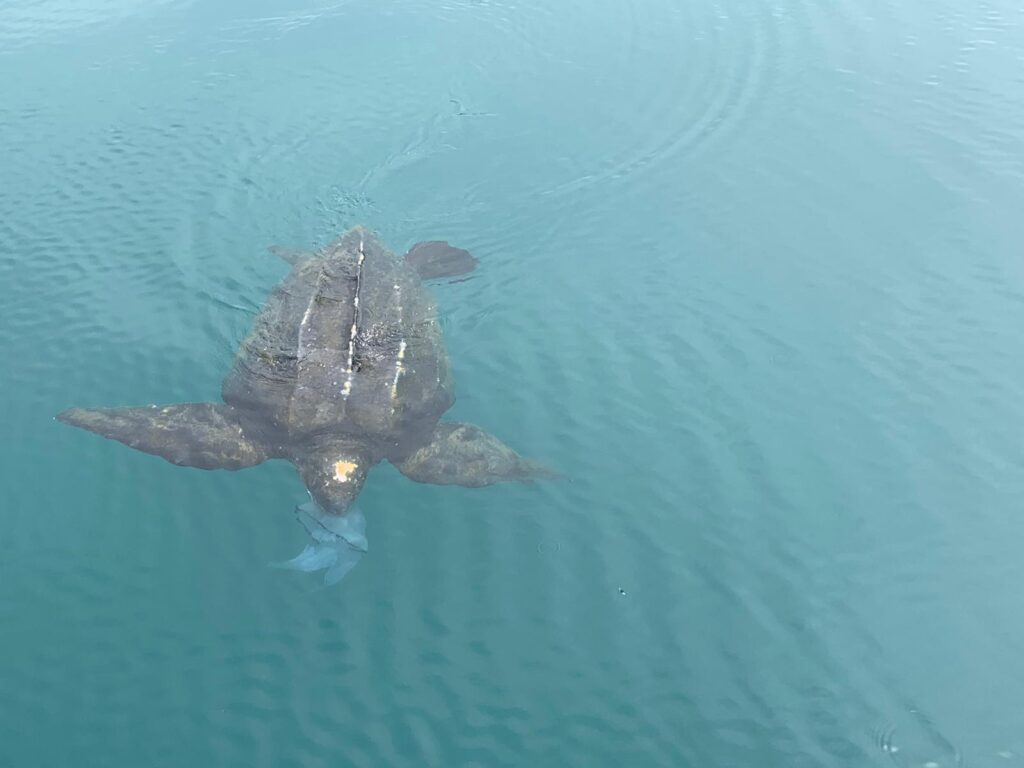
The leatherback turtle is the most pelagic of all sea turtles and can be found in great ocean depths as well as shallow coastal waters. Unfortunately, its preference for jellyfish causes it to mistake plastic bags for food, which has led to significant mortality in this species.
Despite this, they have the ability to dive to more than 1,000 meters deep, regulate their temperature, and migrate across all the world's oceans. Although juveniles are difficult to observe in their natural environment, it is known that the first years of development are critical for this species. In March 1999, three juveniles were accidentally captured off the coast of Príncipe Island in the Gulf of Guinea, providing valuable information about their early development.
It has been recorded that some of these turtles have traveled from nesting beaches in the Pacific to the coasts of Japan and Russia, a journey of more than 20,000 kilometers. During migration, these turtles feed in cold waters and then return to warmer waters to nest.
How long does the leatherback turtle live?
It is estimated that they live around 80 years in the wild.
How big is the leatherback turtle?
The leatherback turtle is the largest chelonian in the world. While the heaviest specimen known reached 950 kg, it is possible that some giant leatherback turtle exceeds a ton in weight. The carapace of an adult leatherback turtle can reach 2 m.
What does the leatherback turtle eat?
The leatherback turtle's diet consists mainly of jellyfish, cephalopods, crustaceans, mollusks, sea urchins, fish, and young sea turtles.
Reproduction of the leatherback turtle
Unlike other sea turtles, copulation is rare and it is not known for certain if it occurs exclusively near nesting sites. During mating, the male clings to the female's back with his long, flexible, and prehensile flippers. A single fertilization is enough for at least ten successive clutches (a record of 17 clutches for the same female has been recorded). These clutches occur at intervals of ten to fifteen days.
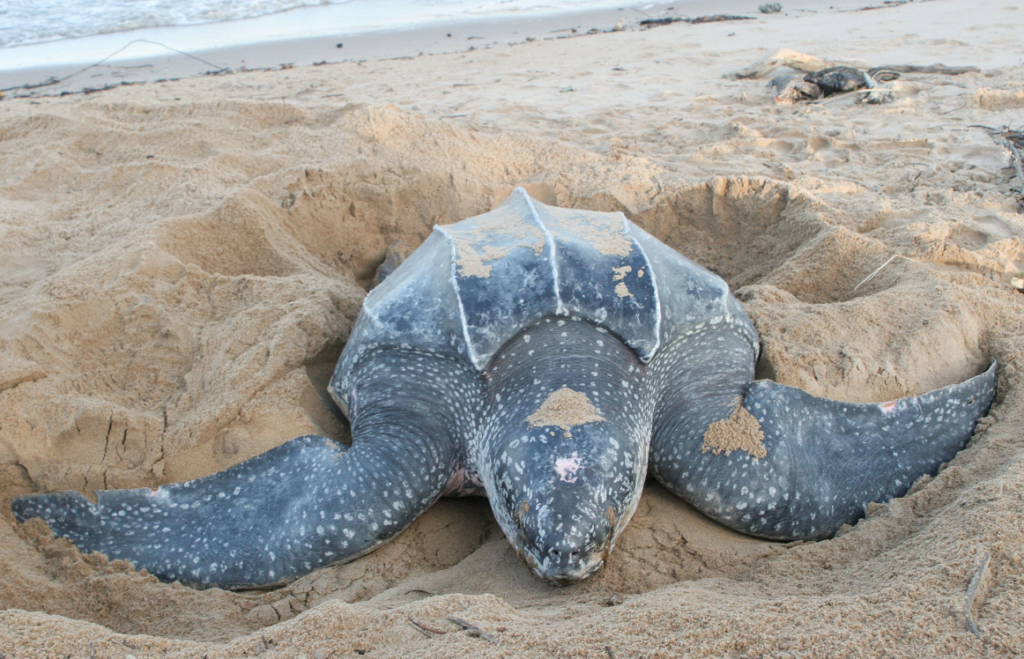
Nesting of sea turtles occurs mainly at night at high tide and consists of 6 phases.
Phases
- Climbing onto the shore.
- Exploring the site.
- Excavating the nest to form a boot-shaped cavity between 70 and 80 cm deep.
- Laying the eggs in large quantities, accompanied by mucus.
- Filling the cavity while the turtle pushes sand with its hind flippers
- Returning to the sea, sometimes with false exits to hide the tracks.
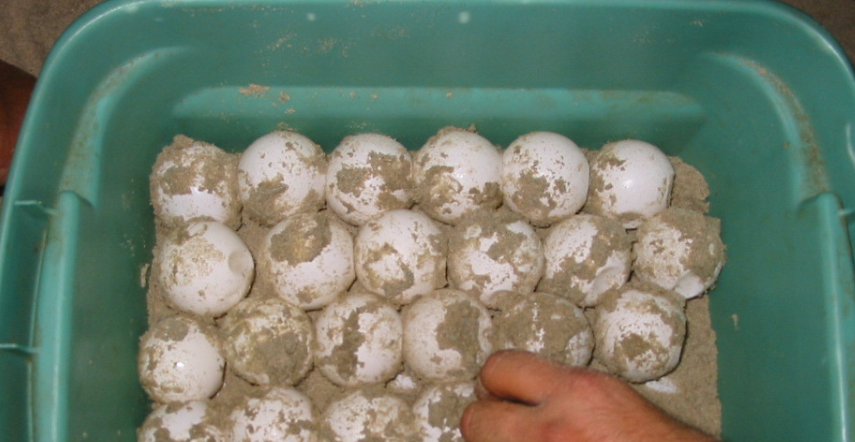
Two types of eggs are laid: the most abundant are white, large, about 5 cm in diameter, with a flexible, parchment-like membrane, and are viable. The other type is smaller, softer, and non-viable, and seems intended only to hide the main eggs. Each female can lay between 100 and 150 eggs in each clutch, which can total up to 1,000 eggs per season.
During nest excavation, females are sensitive to bright lights or disturbances and may interrupt their activity and return to the sea. When laying eggs, they are insensitive to external disturbances. Incubation of the eggs lasts between 60 and 70 days, and the sex of the baby leatherback turtle will depend on the incubation temperature.
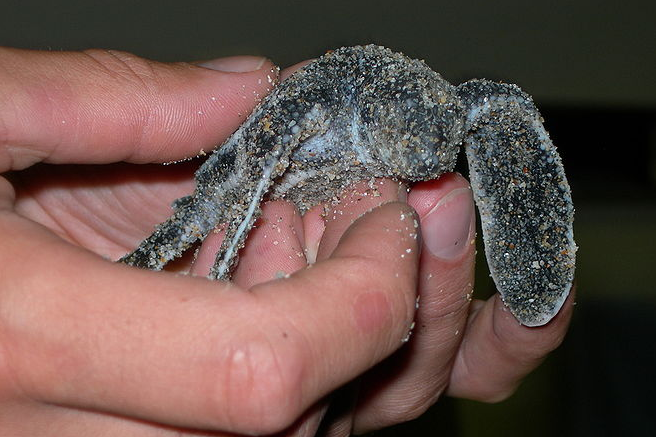
Newborn leatherback turtles have gigantic front flippers and are preyed upon by numerous predators. Juveniles spend their first years unobserved. Adult turtles face threats such as pollution, fishing techniques, collisions with boats, and predator attacks. When attacked by sharks, leatherback turtles protect themselves by presenting their carapace.
Conservation status of the leatherback turtle
The leatherback turtle species faces threats such as alteration of nesting sites, collection of eggs and meat, and accidental fishing. Conservation programs are carried out and turtle excluder devices are used in fishing nets for their survival. There is controversy among specialists about their future and degree of threat, but it remains one of the most studied and protected sea turtles in the world. Organizations monitor certain sites and populations. The leatherback turtle is endangered.