
Hawksbill Sea Turtle
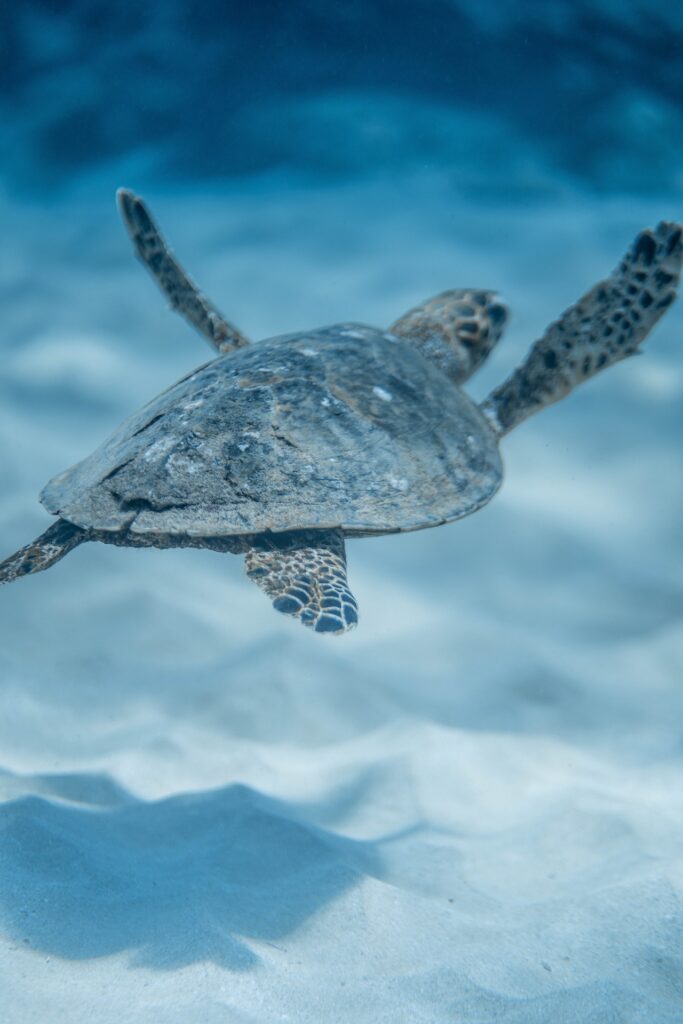
The hawksbill turtle (Eretmochelys imbricata) is one of the most iconic and beautiful sea turtle species in the world. Its reddish-brown shell and mottled skin make it unmistakable. However, the hawksbill turtle is endangered due to poaching and habitat destruction. In this post, we will explore everything you need to know about the hawksbill sea turtle, from its distribution, characteristics, and reproduction to its conservation and habits.
Distribution of the hawksbill turtle
This species has a wide geographic distribution, covering much of the tropical, subtropical, and even temperate regions of the Atlantic, Indian, and Pacific Oceans. However, its presence in the Mediterranean is quite limited and is considered an exceptional event, probably due to its inability to adapt to Mediterranean environmental conditions. Only in rare cases has this species managed to enter the Mediterranean through the Suez Canal, but it is generally not found in this area.
Characteristics of the hawksbill turtle
The most notable feature is the hawksbill turtle shell, which has a heart-shaped and rather elongated form. It is remarkable for the shingle-like arrangement of the carapace scutes, which overlap like roof tiles. This trait may diminish with age, and older individuals may have a smooth carapace similar to other hard-shelled sea turtles.
It has four pairs of costal scutes that do not touch the nuchal. The vertebral scutes may have a slight keel, a remnant of their juvenile form. The marginal scutes are laterally narrow, but often have serrations at the rear and may even be widened and grooved. The last two marginal scutes above the tail form very pronounced points.
The carapace can be yellow, or orange-red with darker markings in shades of brown or black, often with cream to yellow streaks. These patterns slowly fade with age and are replaced by less distinct decoration. The plastron is broad, white, and double-keeled, and sometimes has some dark spots. The front flippers are powerful but relatively thin, with rounded tips and equipped with two claws. They are surrounded by a network of large, more or less elongated scales, encircling a central area covered with smaller scales.
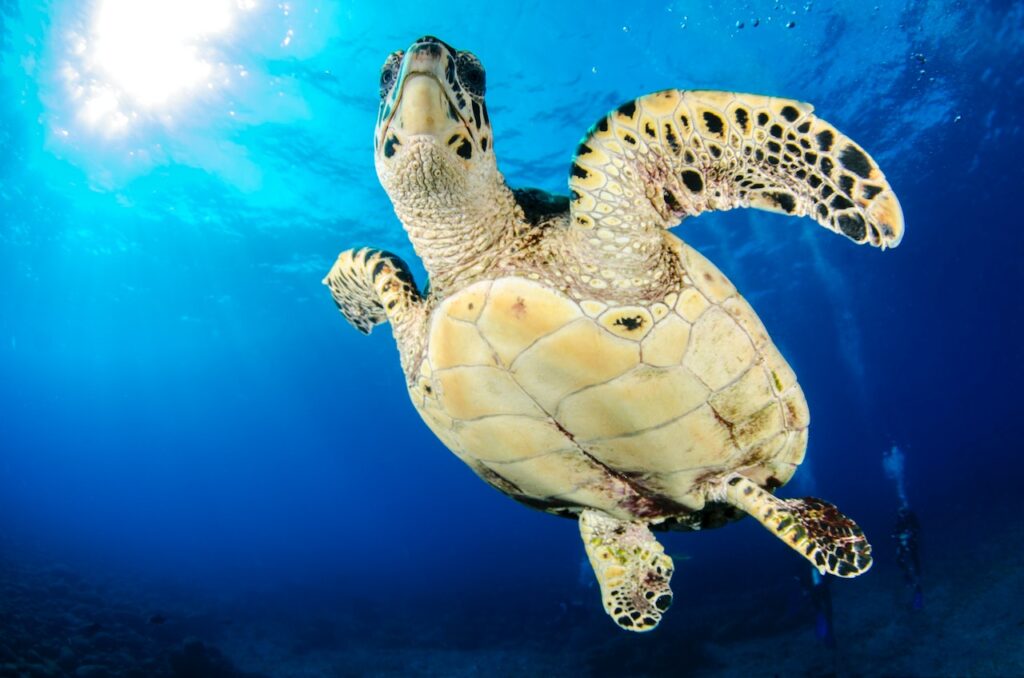
The scales on the underside of the legs and tail are a very pale yellow and darken toward the extremities. The head of this turtle is small and slender, and is notable for its large hooked beak. A shield formed by two pairs of prefrontals and one frontal is found on the head, which is reddish-brown on top and light yellow under the chin. The cephalic scales have a prominent yellow hue.
Juvenile hawksbill turtles
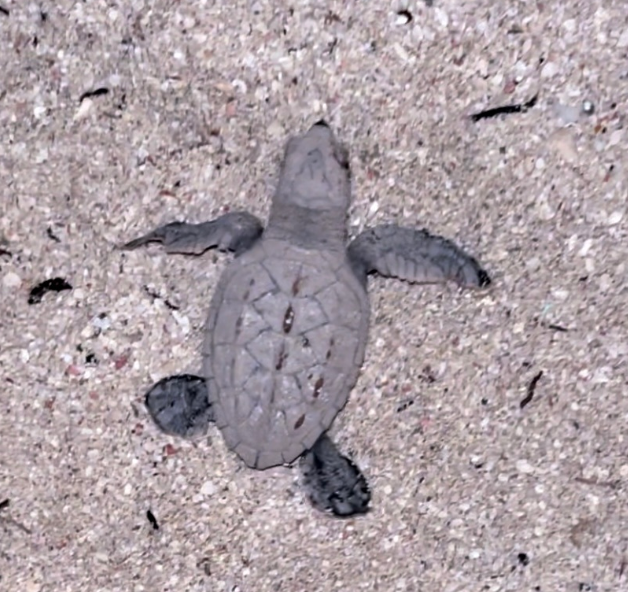
The baby hawksbill turtle has a slightly reddish-brown shell, with a well-developed vertebral keel and a dark plastron that is lighter along the plates. The marginals are very serrated and the front flippers are disproportionately large.
Habits of the hawksbill turtle
The hawksbill turtle is a species that rarely strays far from the coast and is not very migratory. In general, its movements between feeding and nesting areas usually do not exceed 500 km, although there have been some exceptions, such as tagged turtles that have traveled from Yucatán to the Dominican Republic, a distance of about 1,500 km. This turtle species nests on the beaches of tropical and subtropical regions, especially in the Caribbean, Yucatán (Mexico), the Red Sea and Oman, the Mascarenes and Madagascar, northwest Africa, Australia, Indonesia, and Malaysia, as well as the French Antilles.
Subspecies of the hawksbill turtle
The hawksbill turtle has two distinct subspecies:
Eretmochelys imbricata, which is found in the Atlantic Ocean from Massachusetts to Brazil in the west, and from Scotland to the west coast of Africa in the east.
Eretmochelys imbricata bissa, which inhabits the tropical waters of the Pacific Ocean, the Indian Ocean from Madagascar to the Red Sea, East Africa, the Philippine Sea, the Sea of Japan, northern Australia, and along the coasts of the Americas, from California to Peru. The subspecies Eretmochelys imbricata bissa is considered a vicariant species that occupies the rest of the hawksbill turtle's range.
How long does the hawksbill turtle live?
Studies have shown that the life expectancy of hawksbill turtles in the wild is around 30 to 50 years. However, some individuals have been recorded living up to 80 years in captivity. It is important to note that the lives of these turtles can be negatively affected by human activity, such as pollution and the destruction of their natural habitat, as well as poaching and accidental fishing. For this reason, the protection and conservation of these species is vital for their long-term survival.
Hawksbill turtles are a long-lived species and take several decades to reach sexual maturity. In natural conditions, it is estimated that they reach sexual maturity between 20 and 40 years of age. However, this species faces a series of threats that can negatively affect its survival and reproduction.
How big is the hawksbill turtle?
The hawksbill turtle rarely exceeds 1 m in length and 60 kg in weight, and exceptionally can reach 1.5 m and 140 kg.
What does the hawksbill turtle eat?
Among sea turtles, it is known for being the most omnivorous. During its early years, it feeds mainly on plants, but as it grows, its diet expands to include cephalopods, invertebrates, crustaceans, sponges, sea urchins, and corals. To access its food, the hawksbill turtle uses its front flippers to break coral branches and then uses its horny beak to finely crush them. The hawksbill turtle is also known to consume mangrove shoots.
Reproduction of the hawksbill turtle
The mating of the hawksbill turtle takes place in shallow waters of lagoons, near the beaches where they lay their eggs. This process can last several hours, during which the male chases the female to the edge of the beach before mating. To lay their eggs, females select a place with abundant vegetation that allows them to conceal the nest, which they dig behind the vegetation.
The hawksbill turtle can dig its nest in both very hard soil and coarse sand and lays its eggs both during the day and at night. The entire laying process rarely lasts more than an hour. During a season, females can lay three or four clutches, each with a number of eggs ranging from 50 to 200, depending on the size of the female. The eggs are white and spherical, with a parchment-like shell that measures approximately 4 cm in diameter. The incubation period is 50 to 75 days.
Conservation status of the hawksbill turtle
The hawksbill turtle is an endangered species due to poaching and the loss of its natural habitat. The hawksbill turtle is a protected species and it is forbidden to hunt them or collect their eggs. Water pollution is also a determining factor in their population decline.
Despite its critical situation, there are efforts to protect and conserve the hawksbill turtle, including the creation of protected areas, monitoring of their populations, and educating the public about their importance in marine ecosystems.
Why is the hawksbill turtle endangered?
The hawksbill turtle has been a victim of human greed for its beautiful hawksbill shell more than any other marine species. The dorsal keratin plates have long been coveted for their ease of use in covering boxes, combs, tables, and other objects. Although the species is listed in Appendix I and its use is prohibited, objects made from this turtle's shell can still be found in many countries. Sellers argue that these are old stocks, but it is clear that trafficking continues and that the use of its shell is not always legal.
The hawksbill turtle has been severely affected by poaching for its shell, which is prized for its beauty and workability. Although the species is protected and its trade is prohibited, hawksbill items are still found for sale in many places. It is necessary to raise public awareness and protect the nesting sites of the turtle. The turtle's meat is exploited in the Pacific and its consumption is dangerous due to the presence of toxins. Conservation of the species requires the protection of nesting sites, the prohibition of hawksbill products, and proper information for the public and local communities.